
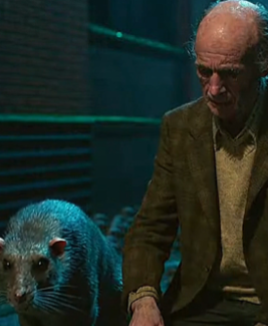
A pack of 100 massive rats swarmed an alley in Oakhaven — not to attack, but to protect a sobbing old man on his knees while a rich kid held a lighter to the last memory of his dead daughter. But the fire they planned was extinguished by the arrival of a hundred fur-covered angels.
The rain in Oakhaven didn’t just fall; it felt like it was trying to wash the city away.
Silas Thorne huddled in the mouth of the alley behind Miller’s Hardware, his fingers blue with cold. He wasn’t looking for trouble. He was just trying to protect the one thing he had left — a small, salt-cracked cigar box tied with a piece of frayed twine.
“What you got in there, Grandpa? Secret treasure?”
The voice was like a jagged piece of glass. Bryce Sterling, the son of the man who owned half the town, stood there with his friends — dressed in five-hundred-dollar hoodies, phones already out, filming for the clout.
“It’s just… letters,” Silas whispered, his voice a dry rasp. “Please. It’s not worth anything to you.”
“If it’s not worth anything, then you won’t mind if we light it up, right?” Bryce pulled out a gleaming silver Zippo. Click-clack. The flame danced in the wet air, a tiny, hungry orange tongue.
Bryce shoved Silas, sending the seventy-year-old man sprawling into the freezing mud. He grabbed the box, mocking Silas’s tears as he prepared to strike the match.
“You’re a nothing, Silas,” Bryce laughed. “A ghost. And ghosts don’t need memories.”
But the fire never touched the wood.
A sound emerged from the fog — a low, rhythmic scratching and scurrying, like the city itself was breathing through the walls. Hundreds of claws on wet pavement. Then the smell hit — musky, primal, ancient.
Suddenly, the alley was no longer empty.
Chapter 1: The Weight of the Flame
The town of Oakhaven was a place where the American Dream had gone to sleep and forgotten to wake up. The factories were hollow shells of rusted iron, and the streets were filled with people who were one missed paycheck away from becoming ghosts.
Silas Thorne had been a ghost for three years.
Before the “Shift,” Silas had been Mr. Thorne — the most beloved English teacher at Oakhaven High. He’d spent thirty years teaching kids the beauty of Frost and Hemingway. But when his daughter, Lily, died in a hit-and-run that the police never solved, the poetry in his soul simply evaporated. He’d lost the house, the job, and eventually, the will to participate in a world that felt so fundamentally broken.
Tonight, the wind was a razor. Silas sat in the alley, his thin tweed blazer — a relic of his teaching days — offering no protection. He clutched the cigar box. Inside were Lily’s graduation speech, her favorite ribbon, and the last letter she’d ever written him.
“Hey, look! The professor is grading papers in the dark!”
Bryce Sterling stepped into the alley, flanked by two other boys. Bryce was the captain of the wrestling team, a boy built of muscle and unearned confidence. His father was currently the lead developer on the “Renewal Project” that was tearing down the shelters to build luxury lofts.
“Bryce,” Silas said, his voice trembling. “Go home. It’s too cold to be out here.”
“I’m just doing some community service,” Bryce sneered. He grabbed the back of Silas’s collar and yanked him toward the brick wall. “Cleaning up the trash. And you’re the biggest piece of trash in the zip code.”
Bryce’s friends huddled around, their smartphones glowing like predatory eyes. One of them kicked Silas’s shins, making him drop the box into the mud.
“No!” Silas gasped, lunging for it.
Bryce stepped on Silas’s hand, the heavy sole of his sneaker grinding Silas’s fingers into the grit. He picked up the box. “What’s this? ‘To Dad, the best teacher in the world’? Gross.”
Bryce pulled out the Zippo. He flicked it open. The flame was a steady, mocking light in the dark alley. “Let’s see how fast ‘the best teacher’ can learn a new lesson. This is called ‘combustion,’ Silas. Watch.”
Silas fell to his knees, the freezing mud soaking into his trousers. He sobbed, a raw, hollow sound that should have moved a stone. “Please, Bryce. I’m begging you. Don’t burn her. That’s all I have left of her.”
“Beg harder,” Bryce laughed, bringing the flame closer to the twine.
But the flame never touched the box.
The silence of the alley shattered.
It began as a whisper — the soft scrape of hundreds of claws on wet concrete. Then it grew into something deeper, something that vibrated in the chest. From the gaps beneath the dumpsters, from the rusted drain grates, from the dark hollow of the loading dock — they came.
The rats of Oakhaven.
They were enormous — survivors of the railyards and the condemned canneries, fed on industrial waste and three brutal winters. The largest among them, a scarred, one-eyed behemoth the color of wet ash that Silas had named Goliath, stepped forward first. His body was the size of a small cat, his tail dragging behind him like a whip. Behind him came Pearl, sleek and gray, and hundreds of others — a living, breathing tide of fur and muscle.
They moved in perfect, silent unison, flowing around Silas like water around a stone, forming a living wall between him and the boys.
Bryce’s laughter died in his throat. The Zippo slipped from his fingers, sputtering out as it hit a puddle. The phones had long disappeared into pockets. The only thing that mattered now were the hundreds of black eyes glittering in the dark.
Chapter 2: The Teacher’s Army
To the people of Oakhaven, the rats of the railyard were a horror — creatures to be poisoned, trapped, and exterminated. The city had spent forty thousand dollars on exterminators the previous spring. Not a single rat had died.
Because Silas fed them.
Every morning at 5:00 AM, Silas would wait behind “The Daily Grind,” the local diner where Sarah Jenkins worked. Sarah was a woman who knew the weight of a hard life. She’d lost her husband to a factory accident and was raising a six-year-old on tips alone.
“Here you go, Silas,” Sarah would whisper, handing him a grease-stained bag of day-old rolls and leftover ham ends. “Keep your head up.”
Silas wouldn’t eat the meat. He’d save it all. He’d walk to the abandoned railyard and make his call — a low, melodic three-note whistle that echoed off the rusted walls like a secret between old friends.
Out they would come. The broken. The discarded. The ones the city wanted gone.
Silas would sit on a rusted rail and break the bread into pieces, talking to them while they ate. He’d recite poetry softly into the dark. He’d tell them, in a voice worn smooth by decades of teaching, that they weren’t vermin — they were survivors.
“A man who shares his last crust is never truly poor,” Silas told Goliath one morning, watching the great rat eat from his open palm. “And a creature who remembers that kindness is never truly a beast.”
The rats understood. They didn’t care about his rags or his smell. They came to him because he was the only living soul in Oakhaven who looked at them and saw something worth saving.
Back in the alley, Bryce was pressed hard against the brick wall, chest heaving, all six feet of his championship-winning frame reduced to something small and pale.
Goliath stepped forward. He didn’t rush. He simply placed himself three inches from Bryce’s sneaker and sat back on his haunches, his single amber eye fixed upward with an intelligence that was deeply, profoundly unsettling.
“Silas…” Bryce’s voice cracked. It was the voice of a child now, thin and high. “Call them off. I was just joking. Here — here, take your stupid box!”
The cigar box dropped into the mud.
Silas crawled forward, his shaking hands finding the worn wood. He wiped the mud from the lid slowly, tenderly, with the hem of his blazer.
“They don’t forget fire, Bryce,” Silas said quietly. “The exterminators came to the railyard last summer with torches. They remember the men who threw the poison pellets. They remember every face.”
“It wasn’t me — I swear —”
“The rats don’t lie,” Silas said. He stood, steadied on his feet by Pearl, who pressed her warm, solid weight against his ankle like a living anchor. “They have better memories than we do. They remember every hand that fed them, and every hand that came against them.”
Headlights swept across the alley. A police cruiser rolled to a stop at the entrance. Officer Mike Miller stepped out, hand moving to his holster by instinct — then freezing completely as his eyes adjusted to the scene.
A hundred massive rats. Packed in tight. Facing three teenagers against a wall.
“Everyone freeze!” Miller’s voice came out steadier than he felt.
He saw the Sterling kid — pale, shaking, back against the bricks. He saw Silas Thorne on the ground, a wooden box pressed to his chest. And then he saw the rats, arranged with a discipline that made the hair on the back of his neck stand straight.
“Miller! Thank God!” Bryce yelled. “This psycho set his rats on us! Arrest him!”
Officer Miller looked at Silas. Twenty years ago, he’d sat in the back row of Mr. Thorne’s English class, failing every quiz, convinced he was too stupid for poetry. Silas had stayed after school with him every Thursday for a month until something finally clicked.
“I don’t see any animals attacking, Bryce,” Miller said, his voice flat and even. “I see three boys trespassing in a private alley with a lighter. And I see an old man with a torn jacket and a box in the mud.”
Chapter 3: The Secret in the Cigar Box
The next morning, Oakhaven woke up to a story it couldn’t ignore.
The tale of the “Rat Army” had spread through the diners and church basements like a wildfire. Howard Sterling had spent the night calling in every favor he had to kill the story at the local paper — but the cell phone footage, the part before the phones got pocketed, had already leaked onto three different social media platforms.
By noon, it had been viewed two million times.
The comments weren’t about the rats. They were about the box. About a father on his knees in the freezing mud, begging a laughing teenager not to burn the last letter his dead daughter had ever written him.
Sarah Jenkins read the story at the diner counter during her break. She didn’t say anything. She just walked to the back, packed a full bag — fresh rolls, a thermos of coffee, a wrapped ham sandwich — and left it at the mouth of the alley with a note that read: You raised an army, Silas. Let us feed it.
By evening, there were forty bags lined up against the alley wall.
Officer Mike Miller filed his report. He was precise and accurate. Bryce Sterling was cited for trespassing and destruction of property. The Zippo was logged as evidence.
In the railyard that night, Silas sat on his rusted rail beneath a sky that had finally stopped raining. He opened the cigar box and, for the first time in three years, took out Lily’s last letter and read it aloud — not to himself, but to the hundreds of quiet, attentive eyes surrounding him in the dark.
“Dad,” it began, “you always told us that the measure of a man is what he does when no one is watching. I think you’re the best man I know.”
Goliath sat on the rail beside him, motionless, as if he understood every word.
Maybe he did.
Leave a Reply