
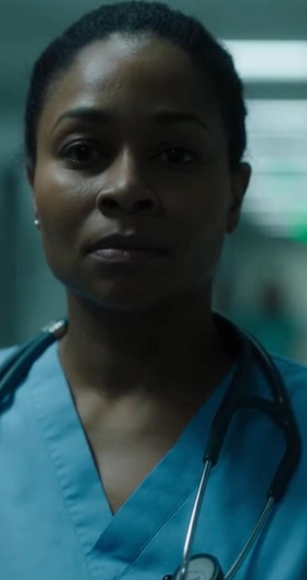
A nurse blocked a man in a $3,000 suit storming through a restricted ICU corridor at 2 a.m. He shoved her aside without breaking stride… But what she saw in his eyes stopped her cold — it wasn’t rage. It was a father shattering from the inside out.
I’ve never told anyone about the night my hands wouldn’t stop shaking in Corridor C.
Not my supervisor. Not my closest colleague. Not even the friend who drove me home that morning when the sun was just beginning to bleed orange across the parking lot and I was still replaying the sound of his shoes.
Click. Click. Click.
I’d held dying patients before. I’d sat beside people in their final minutes, watching the monitors go flat, whispering things I hoped they could still hear. I’d faced screaming relatives who threw clipboards, wept into my chest, and cursed the God they were simultaneously begging. I had seen broken bodies and broken minds and broken families — the whole shattered spectrum of human suffering that a hospital quietly contains.
None of it had ever made my hands shake.
Until him.
It was 2:17 a.m. That hour belongs to no one — it’s the corridor between midnight and morning, where machines breathe louder than patients and the whole building feels half-asleep, half-haunted. The fluorescent lights above Corridor C had that particular hum I’d grown to associate with the long stretch of a twelve-hour shift. I was guiding a medication trolley toward the ICU, my sneakers making soft whispers against the polished floor, when I heard them.
Footsteps. Sharp. Deliberate. Wrong.
I looked up and saw him.
Black suit. Tailored, expensive — the kind that doesn’t wrinkle. Crisp white shirt, collar open like he’d torn himself free from something formal and suffocating mid-journey, the top two buttons undone. His shoes were polished to a mirror shine, and every click they made against the linoleum announced him before his presence could. He wasn’t wandering. He wasn’t lost. He moved like a man accustomed to being the most important person in every room — not because of arrogance alone, but because for most of his life, he probably had been.
His eyes were what stopped me first.
Calm. Too calm. The kind of calm that isn’t peace — it’s suppression. Something enormous being held down by sheer force of will, trembling at the seams.
I stepped into his path. Protocol. Training. Ten years of this shift makes it reflex.
“Sir,” I said, keeping my voice professional, level, practiced. “This area is restricted.”
He didn’t slow down.
I repeated myself, softer this time, gesturing toward the visitors’ waiting area down the hall. “Sir, I need you to—”
It happened faster than I could process.
His hand came out — not wild, not chaotic — controlled. A precise, forceful movement that struck my shoulder and shoved me sideways like I was an obstacle, not a person.
“Get out of my way.”
He didn’t shout it. That was the part that scared me most. There was no explosion in his voice, no heat, no trembling edge of a man losing it. It was flat. Certain. The way someone speaks when they’ve never been told no in a way that actually held.
I stumbled back, my heel catching the raised edge of a floor tile. For one terrible second, I was certain I’d fall — the trolley rattled beside me, a clipboard hit the floor somewhere nearby, and I heard someone gasp. Someone else froze mid-step. A doctor stopped dead, coffee cup halfway to her mouth.
The corridor went silent the way a room goes silent before something breaks.
Pain flared through my shoulder — sharp, immediate, humiliating. But it wasn’t the pain that hollowed me out. It was the shock. The pure, clean shock of being physically moved by another human being in a place I had spent a decade treating as sacred ground.
I straightened. My heart was slamming so hard against my ribs I could feel it in my fingertips.
“Sir.” My voice came out with a tremor I couldn’t control. “You cannot do that.”
He turned. Slowly. As though I’d merely inconvenienced him — the way you turn when a fly won’t stop buzzing near your ear.
“I said move.“
Three words. No volume. Absolute authority.
I felt every pair of eyes in that corridor land on us. Two interns. A resident. A patient in a wheelchair clutching his IV pole with both hands, watching us with the still, wide expression of someone who has stopped breathing. Another nurse beside a curtain, motionless.
No one intervened.
And then a voice came from behind him — firm, loud, cutting cleanly through the tension.
“Step back. That’s enough.”
Security. Or a senior physician. I didn’t turn to look. I couldn’t take my eyes off his face.
Something changed in him.
It was subtle — terrifyingly subtle. His shoulders dropped half an inch. His jaw unclenched. The pressure behind his eyes shifted, like weather patterns realigning. The storm that had been filling his whole body simply… withdrew. Like it had never been there.
He turned slightly, raised one open hand in a gesture so measured it looked rehearsed, and said — almost gently:
“I’m fine.”
And that was it.
The corridor exhaled. People moved again. Sound rushed back — machines beeping, footsteps resuming, the low murmur of whispered conversation. The whole incident folded shut like a letter, sealed and set aside.
But I couldn’t move.
Because in that moment — in the last second before he turned away — I had seen it.
Grief. Not fresh grief, not the wild, gasping kind. The other kind. The kind that’s been living inside someone for too long, that has calcified around the heart and grown edges and points. The kind of grief that has nowhere left to go so it picks a direction and moves.
Security escorted him away. My supervisor appeared. Forms were filled. Apologies were offered — by him, stiffly, with the precision of a man who understood consequences even through agony. She asked me twice if I was okay.
I said yes both times.
I went to the supply room. I sat on the floor between boxes of sterile gloves and saline bags and put my face in my hands.
My hands would not stop shaking.
Everyone assumed it was the push. The violation of it, the shock, the physical assault in a space that was supposed to be protected. My supervisor brought me tea. A colleague hugged me and called him a monster with the easy certainty of someone who hadn’t looked him in the eye.
They were wrong about why I was shaking.
I was shaking because when he looked at me — really looked, in that last second before the calm settled back over him — I had seen something I wasn’t trained to treat and didn’t know how to carry.
I saw a man standing at the exact edge of the only moment in his life when everything he’d built, everything he’d earned and controlled and commanded, meant absolutely nothing.
Later — much later, weeks later, in the way hospitals let information travel slowly and quietly so it doesn’t detonate — I learned who he was.
A father.
His daughter had arrived an hour before him. Twenty-three years old. A car accident on a wet highway — the kind of impact that rearranges the inside of a person without leaving enough visible evidence to prepare you for the truth. Internal bleeding. The silent kind. The kind that waits.
She had been rushed into emergency surgery before he arrived. He’d gotten the call on his cell phone in the back of a car, in the middle of a city that had no idea his world was ending. He had arrived to locked doors and no answers and no one with the authority to tell him anything because the surgeons were already inside, already fighting, and all anyone could offer him was a waiting room and a cup of terrible coffee and please sir, we’ll update you when we can.
He had been standing outside that door, in that waiting room, for fifty-three minutes before he walked into Corridor C.
Fifty-three minutes of helplessness in a life that had been carefully, deliberately, expensively constructed to never feel helpless.
People say anger like that is arrogance. Entitlement. The ugly inheritance of a man who has always had too much.
Maybe. I don’t excuse it. I never will. What he did was wrong — clean, uncomplicated wrong — and the fact that he was suffering doesn’t change what it felt like to be shoved aside like furniture in a corridor I had worked in for a decade.
But I understand it now in a way I couldn’t that night.
Not the action. The origin.
There is a specific kind of violence that comes not from too little control but from too much of it — from a lifetime of being the person who solves things, commands rooms, signs the check that changes outcomes. When that person is faced with something that cannot be solved, cannot be commanded, cannot be signed away — something that simply is and must be waited through — the machinery inside them doesn’t know what to do with the stillness.
So it moves. In any direction. Against any obstacle.
I think about that a lot, in the particular way you think about things that live between your ribs rather than in your mind.
I finished my shift that morning. I drove home in the early light, made coffee I didn’t drink, and sat at my kitchen table for a long time doing nothing. I didn’t file anything beyond what was required. I didn’t tell my friends. I didn’t post anything or process it out loud or reach for any of the outlets we reach for when something shakes us.
I just sat with it.
Because some things resist the shape of a story you tell other people. They don’t want to be shared or witnessed or explained. They want to be carried, quietly, in the place where the true things live.
Hospitals see people at their most exposed. Not their best, not their worst — their most. The polish comes off. The titles stop mattering. The years of carefully constructed self dissolve under fluorescent lights at 2 a.m. when the person you cannot live without is behind a door you cannot open.
That night, I saw a man dismantled by love wearing the armor of anger.
And I saw myself — small, frightened, still standing. Still there. Still the person between him and the door he needed to breach.
That’s the job.
Not just the medicine. Not just the protocol. The standing. The staying. The choosing, over and over again, to remain present for people at their most dangerous, their most broken, their most unbearably human.
Every time I walk Corridor C on a night shift — every time that particular hum of the fluorescent lights lands in my chest and the hour hits that strange, suspended quality of 2 a.m. — I hear it.
Click.
Click.
Click.
And I remind myself why I stay.
Because even the people who push you away at their worst — especially them — are still people.
And somewhere down that corridor, there is always someone waiting for the only person in the world who makes their power feel meaningless.
That’s worth showing up for.
Every single night.
.
Leave a Reply