
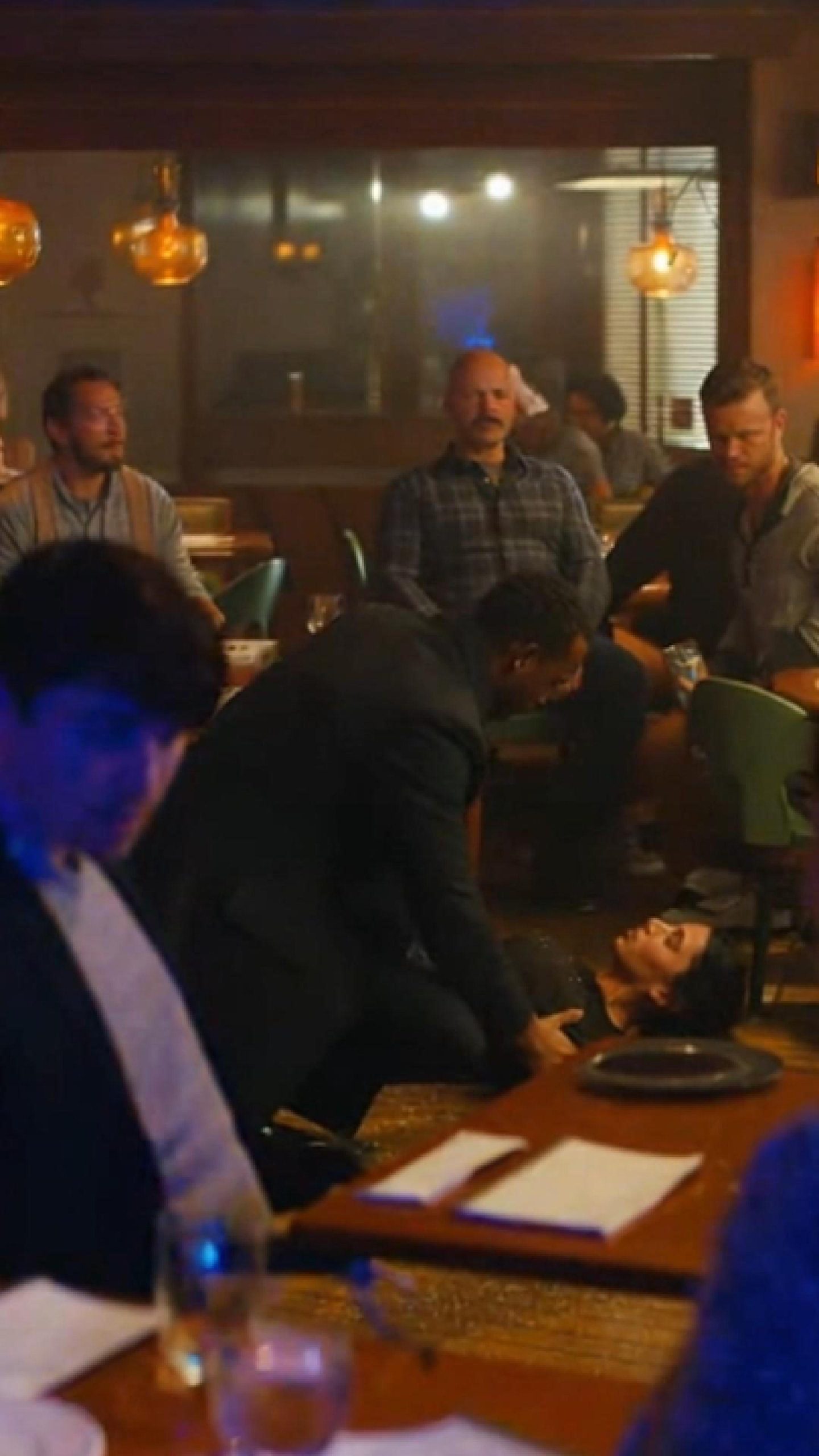
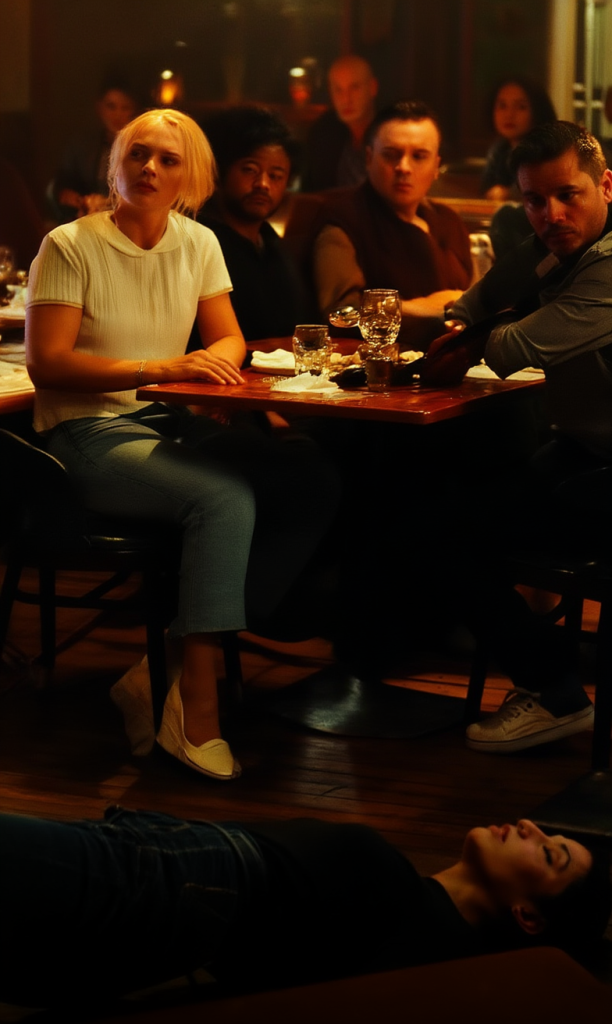
She was face-down in broken glass, bleeding, begging for help — and a room full of people just watched… But then a man walked in that every single person in that restaurant was afraid of, and he was the only one who knelt down beside her.
The kind of cold that settles into a city in November doesn’t just drop the temperature — it changes the character of indoor spaces entirely. The Harbor Street Grill felt warmer for it. Amber light gathered under low pendant lamps. The hiss and clatter from the open kitchen mixed with low jazz from a speaker near the bar, and the result was the particular music of a place where people felt, at least temporarily, that the world outside had nothing to do with them. Claire Delaney had been working the floor here for going on four years. Long enough to know that the two-top near the window always wanted their check before they asked for it, that the older gentleman at the bar on Tuesday nights ordered bourbon and nursed it for two hours and never wanted to talk but always wanted to be noticed, and that the quickest way to turn a bad tip into a decent one was to remember what somebody ordered last time and mention it before they did. She wasn’t thinking about any of that tonight. She was thinking about her sister. Mara was seventeen, a junior at Jefferson High, and had been accepted — pending a financial aid package that was still very much pending — to a nursing program that started in the fall. Claire had done the math forty different ways.
The numbers didn’t change. What changed was how hard she worked the floor, how many doubles she picked up, and how carefully she kept the worry off her face so that Mara wouldn’t feel like a burden. “Claire, table nine’s asking about the halibut special again,” Marcus called from behind the line. “Tell them it’s the best thing on the menu,” she said without turning around, already moving toward table nine with a water carafe and a smile she’d learned to mean. She first noticed the man near the entrance the way she noticed everything — peripherally, professionally, without stopping. He was sitting alone at a two-top by the door. No food in front of him. No menu. Just a glass of water he hadn’t touched and the look of someone waiting for something that hadn’t arrived yet. His jacket was heavy and worn at the elbows. His eyes moved around the room in a way that had nothing to do with reading the ambiance. She’d seen that look before. Usually it ended fine. Sometimes it didn’t. When she came back around with the check for table seven, she stopped at his table. “Can I bring you anything? We’ve still got the halibut if you’re thinking about dinner.” He looked up. The irritation was immediate and practiced, like a reflex. “I’m not eating. Leave me alone.” “Of course.” She kept her voice easy. “I’ll check back.” She’d made it exactly four steps when she heard the scrape of the chair — that specific sound, hard and sudden and wrong for the room. She turned just as he stood, and he was already too close, already moving, and then his arm came out and she was falling. The glass table behind her didn’t give. She did. The sound was enormous in the small space — a detonation of glass that compressed the whole restaurant into a single shocked breath. Then silence. Then, from somewhere near the bar, a woman screamed. Claire was on the floor among the broken pieces. The pain arrived in layers — first her back, then her elbow, then a deep specific burn from her left palm where glass had found skin. She tried to breathe and couldn’t, and then could, and the air tasted like blood. “Someone—” She couldn’t get enough breath behind it. “Please.” The room heard her. She could tell by the quality of the silence that followed — not empty, but full. Packed with the held breath of two dozen people deciding what to do. They decided to stay still. Fear operates on otherwise decent people like a paralytic. You can see it happening in them — the forward lean that doesn’t complete, the hand that rises and stops, the eyes that want to look away and can’t. The man who had pushed her stood over the chaos with a kind of wild authority, his gaze sweeping the room. “Nobody needs to be a hero,” he said. His voice was too loud and carefully controlled. “Sit back down.” Claire pressed her good hand against the floor and tried to rise. Pain shot up through her palm where the glass was. She dropped back. She was thinking about Mara. About the financial aid packet on the kitchen table with the stack of paperwork she hadn’t finished. About the Tuesday she’d promised to drive her to the open house and had to cancel because of a double shift, and how Mara had said it was fine with the particular tone of a person for whom things are not fine but who loves you too much to say so. The front door opened. It opened the way front doors don’t usually open — with weight, with intention, with the cold coming in not as a draft but as a presence. Every head in the room turned before the man was even fully inside, and for a fraction of a second Claire thought: they’re turning because they’re scared. Not surprised. Scared. He was tall and dressed in a dark suit that fit him with the kind of quiet precision that announces money without advertising it. His face was still in the way that faces become still when stillness has been useful for a long time. Behind him, a step back and a step to the right, stood a larger man whose stillness was of a different kind — the stillness of someone whose job is to watch. The man near Claire straightened. Something crossed his face — not anger, not challenge. Recognition. And below that: fear. The suited man took in the room without hurrying. The shattered glass. The frozen diners. The standing man. And then Claire, on the floor, her hand pressed to her chest, her eyes finding his without meaning to. Something moved in his expression. Brief and specific, like a word said quietly in a crowded room. Then it was gone. “What happened in here?” The question was quiet. Which somehow made it fill more space than a shout. No one answered. The man who had pushed her tried to recover the moment. “None of your business. Walk away, friend.” The suited man was not his friend. He didn’t say so. He just stepped forward, once, unhurried, the way a door swings shut — not fast, just final. His companion moved with him.
The man near Claire watched them come and the calculation on his face turned and turned and came up short. “I said walk away!” No reaction. Just another step. The suited man stopped beside Claire and looked down. She watched his eyes move across her injuries — the bleeding palm, the way she was holding her arm, the glass around her — with the careful attention of someone taking inventory. He crouched.
The glass shifted under his shoe and he moved to avoid it, precisely, without looking down. “Are you hurt anywhere you can’t feel yet?” She blinked. It was such a specific question. “My hand. My back. I don’t — I don’t know.” He nodded like she’d given him exactly the information he needed. Behind him, she heard the sound of the larger man intercepting the one who’d pushed her — not a fight, barely a scuffle, over before it resolved into anything real. A chair went over.
Someone at the bar inhaled sharply. Then it was quiet again, and the suited man was still crouched beside her, entirely unconcerned with what was happening behind him. Up close, she could see the lines around his eyes — not old, exactly, but settled, the kind of lines a face makes when it has been asked to stay composed through things that call for a different expression. There were scars on his knuckles, faint and old, the kind you stop noticing on your own hands. He reached behind him and shrugged off his jacket. He folded it with two efficient movements and placed it beneath her head.
“Don’t try to move until the paramedics get here.” “You don’t have to—” she started. “I know,” he said. In the distance, sirens. Someone had finally made the call. “Why are you helping me?” She didn’t mean to ask it out loud. It was the kind of question she’d normally keep to herself, file away, revisit at 2 a.m. He was quiet for a moment. Not like he didn’t have an answer — like he was deciding which true answer to give.
“Because you needed it,” he said finally. “And no one else was doing it.” No flourish. No performance. Just a fact, stated plainly, like the temperature or the time. The restaurant was different now. She could feel it even from the floor — the quality of the air had changed, the paralysis had broken, people were moving, voices were overlapping. Someone brought a clean tablecloth from the linen rack and laid it over the worst of the glass near her. A woman from table eleven was on the phone with 911, her voice low and urgent. The man who had pushed her sat in a chair by the door with the larger man standing behind him with his arms crossed, and whatever that man had been in this room twenty minutes ago, he was smaller now. Red and blue light came through the front windows before the door opened again. Officers. Paramedics. Voices making order out of the room. As the stretcher came level with her and they prepared to move her, Claire turned her head toward the door. He was already standing near the exit. Not leaving yet — just near the door, the way a decision stands near the moment of being made. His companion had stepped outside. He watched the paramedics work with an expression she couldn’t fully read, something behind the stillness that might have been relief, or might have been something older. Their eyes met for the last time. She had questions she hadn’t asked. He had answers he probably wouldn’t have given. “Thank you,” she said. It came out smaller than she meant it. He gave one nod — small, deliberate — and then he turned and walked out into the November cold. By the time the stretcher reached the doors, he was gone. Later, in a hospital room with Mara asleep in the chair beside her, her shoes still on, her phone slipping from her hand, Claire stared at the ceiling and let the night move through her in sequence. The glass. The silence. The fear. The door opening. The jacket under her head, which she was still wearing — the paramedics had used it as a cushion in the ambulance and it had come with her, dark wool that smelled faintly of cedar and something she couldn’t name. She still didn’t know who he was. Didn’t know what kind of man arrived at a restaurant in a dark suit with a bodyguard and then knelt on a floor full of broken glass to ask a stranger whether she was hurt somewhere she couldn’t feel yet. But she thought about what he’d said. Because you needed it. And no one else was doing it. There’s a version of the world where people are sorted into simple categories — the ones who help and the ones who don’t, the safe ones and the dangerous ones, the heroes and the rest. It’s a version that’s easy to explain and almost entirely wrong. The people in that restaurant tonight were not bad people. They were frozen people. Decent, frightened, ordinary people with the best intentions and paralyzed bodies. And the man who walked through the door and did the thing that needed doing — the man whose name she didn’t know, whose life she couldn’t begin to guess at, who carried himself like someone fluent in rooms where things go wrong — he was not a simple man. She knew that much.But simple men, she thought, don’t ask the right questions.
Outside the hospital window, the city was still going. Lights in office towers. Taxis below. Somewhere out there, a man in a dark suit walked through the cold with his hands in his pockets and whatever he was carrying that no one could see. She pulled his jacket tighter around her shoulders and let herself sleep.
Leave a Reply