
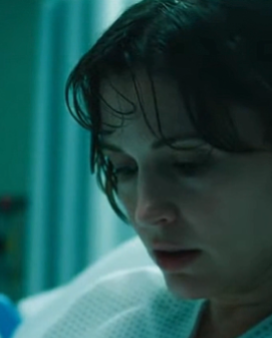
She survived sixteen hours of labor — only to look down at the baby in her arms and whisper: “This is not my son.” The hospital said she was wrong. Her chart said she was wrong. But a mother’s instinct said something far darker was happening behind those sterile white walls.
The room smelled like antiseptic and quiet desperation. Emma Lawson lay still on the narrow hospital bed, every muscle in her body trembling in the aftermath of what it had just been through. Her dark hair was plastered to her cheeks. Her hospital gown clung to her damp skin. The fluorescent lights above flickered — or maybe that was just her exhaustion playing tricks. Sixteen hours. Sixteen hours of labor. Sixteen hours of watching the clock. Sixteen hours of gripping Daniel’s hand so hard she’d left marks on his palm. Sixteen hours of telling herself: it will be worth it. He will be worth it. Her son. The word alone made her throat tighten. “Where is my baby?” she asked, her voice barely carrying past her own lips. The nurses had moved quickly after delivery. There were hushed words she hadn’t been able to catch, quick footsteps, someone saying “routine checks” in the smooth, reassuring tone of someone who’d said it a thousand times before. Emma had been too exhausted to chase them down the hallway. She had trusted them. She was already regretting that. Minutes passed. Too many minutes. The door finally opened with a soft hydraulic whisper. A nurse entered — professional smile, soft steps, a bundle of white blanket cradled in her arms. She crossed the room and lowered the baby gently into Emma’s waiting arms, murmuring something warm and scripted about motherhood. Emma looked down. And stopped breathing. The baby had thick, dark hair. A full head of it. Emma remembered — with perfect clarity, the way you remember the most important moments of your life — touching her son’s smooth head right after delivery. He had barely any hair. Just a faint, fine dusting. She had laughed softly about it through her tears. She looked closer. The skin tone wasn’t right. The shape of the nose. The chin. Small differences, each one easy to dismiss on its own. Together, they hit her like a door swinging open onto a cold hallway. “This is not my baby,” she said. The nurse’s expression didn’t change. “Ma’am?” Emma’s hands began to shake — not from weakness now, but from something else entirely. “This is not my baby.” “I understand you’re overwhelmed—” “You think I can’t recognize my own child?” Emma’s voice cracked through the room like a fault line. “I felt every kick for nine months. I know this is not him.” The nurse’s professional calm flickered. Just for a moment. Just long enough. Emma saw it. And that moment changed everything. Outside in the hallway, two nurses stood close together at the station, voices barely above a whisper. “She noticed already.” “How? It’s been ten minutes.” “I told you. I told everyone this was dangerous.” The door at the end of the hall opened. A man in a gray suit walked through it with the particular quiet authority of someone who had never once needed to raise his voice to get what he wanted. The nurses straightened instinctively. “Is there a problem?” he asked. “The mother.” A pause. “She’s refusing the baby.” He said nothing for a moment. Just nodded once, slowly. “Handle it.” Back in Emma’s room, the doctor arrived with practiced composure, his white coat pressed, his voice measured and paternal. “Mrs. Lawson,” he began. “After delivery, it’s completely normal for your perception to be—” “Stop.” Emma’s jaw was set. “Don’t talk to me about perception.” She had laid the baby carefully on the bed beside her. She wasn’t rejecting the child. She just couldn’t hold him and also hold onto her sanity right now. “I want my son’s records,” she said. “His footprint. His ID bracelet. Whatever you put on him when he came out.” “Hospital policy—” “Then call my husband.” She reached for the call button on the bedside rail. “Or call security. Or call your supervisor. But I am not accepting this baby until someone brings me proof.” The doctor exchanged a glance with the nurse. Emma caught it. That look. That small, silent conversation happening right in front of her face. Her blood turned to ice. Twenty minutes earlier, in another wing on the same floor, a different woman lay unconscious in a private suite that cost more per night than most people paid in rent. Her name was Olivia Carter. Her husband, Richard Carter, ran a pharmaceutical company worth nine figures. Her family had foundations named after them and wings of university hospitals dedicated to their generosity. Olivia had delivered a son as well. Seven pounds, four ounces. Born four minutes before Emma’s baby. But the baby had been taken immediately to the neonatal unit. A doctor had confirmed what the prenatal screening had first suggested: a rare genetic condition. Non-fatal. Manageable. But visible. Progressive. The kind of thing that would require lifelong care — and generate lifelong questions. The gray-suited man had stood over the incubator, reading the file. His name was Hargrove. He managed “special situations” for the Carter family. He had been doing it for eleven years. “Can it be kept confidential?” he had asked. The doctor who answered him — a man with a mortgage he couldn’t afford and two children in private school — had hesitated just a second too long. “There are certain protocols—” “I’m not asking about protocols,” Hargrove said softly. “I’m asking if it can be kept confidential.” He had set two files side by side on the clipboard. Carter. Lawson. Two boys. Same floor. Same hour. One with a condition that would complicate the Carter family legacy. One perfectly healthy, born to a schoolteacher and a civil engineer from Columbus, Ohio. The decision was made quietly, the way the worst decisions always are. Back in Emma’s room, Daniel arrived at a near-run, his jacket half-on and his face stripped of all composure. “Emma — what’s happening? The nurses wouldn’t tell me anything.” “They gave us someone else’s baby.” He looked at the child on the bed, then at Emma, then at the nurse by the door, then back at Emma. “What?” “Look at him, Daniel. Look at him.” Daniel leaned over the baby. He had met his son for exactly forty seconds before the nurses took him for “routine checks.” He had been so stunned by the miracle of it that he hadn’t catalogued every detail the way Emma had. But he trusted Emma absolutely. He pulled out his phone. “I’m calling our lawyer.” That was when Hargrove appeared in the doorway. “There’s really no need to escalate this,” he said. “I’m sure we can resolve the confusion.” “Who are you?” Daniel asked. “Hospital administration.” Emma stared at him from the bed. She had seen him before. Right after delivery, while she was still half-conscious from the epidural wearing off. He had been standing in the corridor outside her room. Not looking at charts. Not talking to anyone. Just watching the door. “Where is my baby?” Emma said. Hargrove met her gaze. She saw the calculation happening behind his eyes — the rapid assessment of risk and exposure and how much she actually knew versus how much she suspected. “You’ve been through a physically and emotionally extreme experience,” he said. “Sometimes—” “My son had no hair,” Emma said clearly. “A small birthmark just below his left ear. I touched it. I kissed it. I told him he was beautiful.” Silence. Then an alarm cut through it from somewhere down the hall. A different alarm. Medical. Urgent. A nurse appeared in the doorway, her face pale. “The Carter baby is in distress.” Hargrove’s expression cracked for just half a second. It was the most honest thing Emma had ever seen on a human face: pure panic, rapidly suppressed. Daniel stepped toward him slowly. “Take us to the nursery.” It was not a request. The neonatal unit was organized chaos. Three doctors crowded around an incubator in the far corner. Machines screamed in short, sharp intervals. A respiratory therapist was already in motion. But Emma’s eyes had gone somewhere else entirely. A bassinet. Near the window. A baby boy, alone, sleeping with the complete and oblivious peace of the newly born. She crossed the room before anyone could stop her. She looked at his ID bracelet. Carter. She looked at his head. Fine, soft hair. Almost none at all. She turned him — gently, carefully — and found the small raised mark just below his left ear. Her lungs stopped working. Daniel had followed her. He looked at the bracelet. Then he looked at the residue on the underside — the ghost of a removed label. With a thumbnail, he worked at the edge of the printed tag until it peeled back slightly, revealing the adhesive beneath. And beneath that: the ghost of a previous print. L-A-W-S-O-N. “You switched them,” Daniel said. He wasn’t shouting. His voice was completely flat. The flatness of someone who had stepped past disbelief into something colder. Hargrove said nothing. Security entered the room. But they were already too late to protect what Hargrove had been trying to protect, because one of the nurses — the one who had trembled when she clipped the wrong bracelet onto a healthy baby boy’s wrist — had already taken out her phone and called someone who was not hospital security. “They made us do it,” she said, stepping forward. Her voice was shaking badly. “They said it would be simple. They said no one would ever know.” Emma was already lifting her son. She held him against her chest, both arms wrapped around him, and she didn’t care about anything else happening in that room. Not the alarm. Not Hargrove. Not the doctors. Not the chaos. She just held him. “Hi,” she whispered. “I’m sorry. I’m so sorry it took me this long.” He stirred slightly in his sleep, made a small sound, and settled. Police arrived forty minutes later. Hargrove was escorted from the building without resistance. The doctor who had agreed to it resigned before he could be suspended. Two nurses gave formal statements. Richard Carter — who may or may not have known the full scope of what his fixer had arranged — issued a statement through an attorney that satisfied no one. The story broke by midnight. Emma didn’t read any of it that night. She lay in a different room — quieter, away from the chaos — with Daniel in the chair beside her and her son sleeping on her chest, rising and falling with each breath. “You saved him,” Daniel said quietly, somewhere around three in the morning. Emma shook her head. “No,” she said. “I just listened.” She kissed the top of his smooth head. “He saved himself.” Outside, the world was loud with headlines and outrage and the machinery of accountability grinding into motion. Inside that room, none of it reached them. There was just this: a mother, her son, and the fierce, quiet certainty that some things — no matter how many people in gray suits try to rearrange them — simply cannot be unmade. A mother always knows. Even when the world tells her she is wrong. Even when the records disagree and the doctors explain and the powerful men speak in calm, reasonable voices about perception and exhaustion and the overwhelming nature of new motherhood. She knows. And when she refuses to be silent — when she holds that knowing like a flame against the wind — she changes everything.
Leave a Reply