
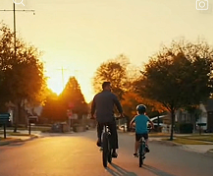
A speeding driver forced my son off the road, laughed in his face, and told him he didn’t belong there. Then he saw who was waiting for him.
The afternoon had that particular suburban stillness to it — long stretches of asphalt baking under a pale sun, the kind of road where drivers unconsciously press the gas a little harder because nothing feels urgent. No school zones. No stop signs in sight. Just open road and the quiet hum of ordinary life.
My son, Marcus, rode a few feet ahead of me. Thirteen years old, but he rode like someone twice his age — deliberate, focused, hugging the shoulder the way I’d taught him since he was eight. Helmet buckled tight. Eyes forward. Reflective strip on the back of his jacket catching the afternoon light.
I’d been teaching him to ride in traffic for two years. Not because I wanted to rush him, but because I believed a kid who learns to navigate the world carefully — who learns to hold his space without apology — carries that with him forever.
We’d done this route a dozen times.
Then I heard the engine.
It wasn’t the usual sound of a passing car. It was aggressive — the kind of acceleration that tells you the driver isn’t thinking about anything beyond themselves. A silver sedan, maybe a year old, the kind of car that costs enough to make some men feel untouchable.
It drifted right.
Not a correction. A drift. The lazy kind that comes from someone on a phone, or someone who simply doesn’t register a boy on a bike as a reason to adjust.
I shouted Marcus’s name.
The car swerved again — and this time, I knew it wasn’t distraction. It was impatience. The sedan clipped the edge of the bike lane, close enough that the wind pressure alone pushed Marcus sideways. His tire hit a strip of loose gravel near the curb and he went into a skid, arms tensing, body jerking left, fighting to stay upright.
He did. Barely.
I hit my brakes so hard my bike fishtailed. I was off it before it stopped moving, crossing the shoulder in three strides, reaching Marcus before the adrenaline had even peaked in my chest.
“I’m okay,” he said before I could ask. His voice was controlled. His knuckles weren’t — white against the handlebars, trembling just slightly.
The sedan didn’t leave.
It slowed. Stopped maybe forty feet ahead. Then, slowly — almost casually — reversed until it was level with us.
The window rolled down halfway.
He was in his mid-forties. Expensive haircut. Aviator sunglasses. The kind of expression that told you he’d never once in his adult life been made to feel small. The smirk was already there, already loaded, like he’d practiced it.
“You need to teach your kid where he belongs,” he said. “This isn’t a playground.”
I felt the words land in my chest like something physical.
But it was Marcus who spoke first.
“You almost hit me.” His voice cracked on the first word, then steadied — the way you hear a boy deciding, in real time, whether to shrink or stand. “You pushed me.”
The man didn’t flinch. He laughed. Not nervously. Not the laugh of someone caught doing something wrong and trying to defuse it. Genuinely amused. Like my son’s fear was a mildly entertaining inconvenience.
“I didn’t touch you. Relax.”
I stepped forward. “You forced him off the road.”
He shrugged. One shoulder. Barely even that. “He shouldn’t be here.”
By then, other cars had slowed. A pickup truck had eased onto the shoulder twenty yards back. A woman in a minivan had her window down. Someone was already raising a phone.
The man didn’t seem to notice — or didn’t seem to care.
He leaned out farther, settling into it now.
“People like you always think the road owes you something.”
People like you.
I noted the phrase. Filed it.
Marcus swallowed. “You didn’t even slow down.”
The driver tilted his head, performing patience now. “And you’re still standing, aren’t you?”
I could feel my pulse in the side of my neck — that specific drumbeat that arrives when your body knows you’re close to a line. But I’ve spent twenty years learning to operate on the other side of that line. To be colder when others get louder.
I took out my phone.
Made one call.
Said four words.
The man watched me. “Calling the cops?” he sneered. “Good luck explaining why your kid’s riding in traffic.”
I didn’t respond.
I checked on Marcus. Straightened his helmet. Looked at his hands until they stopped shaking.
Eight minutes.
That’s how long it took.
The air shifted before anything was visible — the way it does before a controlled thing arrives rather than a chaotic one. No sirens. No shouting in the distance.
Just engines.
The first black SUV came from the north end of the road, moving at exactly the speed limit. Then another from the south. Then two more, sliding into position with the quiet precision of people who had done this kind of thing so many times it required no discussion.
The sedan was enclosed before the driver understood what was happening.
He pushed his door open. Stopped when a man in a charcoal suit stepped directly into his path — not aggressively, not with a hand raised. Simply present. Calm as a wall.
“Sir,” the man said. “Please stay where you are.”
The driver laughed — but it was too loud this time, the laugh of someone recalibrating. “You can’t do this. This is a public road.”
“We’re not doing anything,” said another suited man, now standing behind the sedan. “We’re just here to talk.”
Marcus stepped closer to me. “Dad,” he said quietly, “who are they?”
I put my hand on his shoulder. “They work with me.”
The driver looked at me again. Really looked — the sunglasses were off now, and I could see the moment it registered. The small, precise recalibration behind his eyes.
“You set this up?” The smirk was gone. “Over a bike?“
I walked toward him slowly.
“Over my son.”
“I didn’t hit him,” he said again, but the confidence had a crack in it now.
One of my men held up a tablet. Turned it toward the driver with the quiet efficiency of someone presenting evidence in a room where the outcome was never in doubt.
“Your front-facing dashcam shows you accelerating while entering the shoulder,” he said, his voice as neutral as someone reading a weather report. “Twice. Four-second intervals.”
Another voice, from near the pickup:
“And this gentleman has footage from the moment you drifted right.”
The truck driver raised his phone. Nodded once.
The sedan driver’s jaw tightened. He was doing the math now — the specific, unpleasant math of a man realizing that the story he’d already told himself about this afternoon was not the story anyone else was going to accept.
“You’re blowing this completely out of proportion,” he said. His voice had changed — not quieter, but more careful. “Kids get scared. It happens. It’s not—”
Marcus spoke before I could.
“You told me I didn’t belong on the road.”
The man turned to him. Opened his mouth.
“I didn’t mean it like—”
“Yes, you did,” Marcus said.
He wasn’t shaking anymore. He was standing with both feet planted, looking at a grown man the way you look at something that has briefly frightened you and then revealed itself to be smaller than it appeared.
“You laughed at me,” my son said. “I almost fell. And you laughed.”
The silence that followed was the specific kind that happens when truth lands in a space with nowhere to go. Even the idling engines seemed to pull back from it.
I let it sit for a moment.
Then I turned to the driver.
“You’re going to apologize.”
He blinked. “Excuse me?”
“To him,” I said. “Not me. To Marcus.”
Something flickered across his face — the old instinct, the familiar reflex of a man accustomed to the world bending around his comfort. “I don’t owe—”
One of my men shifted almost imperceptibly closer. Still polite. Still calm.
“Sir,” he said, “this ends quickly if you choose the right words.”
The driver looked around. At the phones. At the faces watching from slowed cars. At the SUVs, still idling, going nowhere. At my son, who was looking at him without blinking.
He exhaled through his nose.
“I’m sorry,” he muttered.
I shook my head. “Try again.”
He swallowed.
“I’m sorry,” he said — louder this time, turning his body fully toward Marcus. “I shouldn’t have done that.”
Marcus looked at him for a long moment. The kind of look that doesn’t rush to fill silence.
“You scared me,” he said finally. “You scared me and you didn’t care. You laughed.”
“I shouldn’t have scared you.” The man’s voice was flat now, hollowed out, the performance fully gone.
That wasn’t the end of it.
Because I’ve learned — professionally and personally — that accountability without consequence is just theater.
One of my men stepped forward and handed the driver a card.
“Your insurance carrier will be contacted regarding the dashcam footage,” he said. “The Department of Motor Vehicles will receive a formal complaint regarding the incident, with supporting evidence attached. Your license review has already been flagged.”
The driver’s face went pale in a specific, slow way — the color leaving from the center outward.
“You can’t—”
“We already have,” the man said pleasantly.
I knelt down in front of Marcus. Looked him in the eye.
“You okay?”
He thought about it — actually thought about it, the way he does, the way I’ve always loved about him.
“Yeah,” he said. Then: “Dad. I want to keep riding.”
I smiled. It surprised even me — how full it felt.
“We will,” I said.
As we walked back to retrieve our bikes, I heard the driver’s voice behind us, quieter now. Stripped of its earlier certainty.
“Who are you people?”
None of my men answered.
They didn’t need to.
Because the question wasn’t really about titles or credentials. It was the question of a man who had spent a lifetime believing that power meant the freedom to make others feel small — finally standing in the presence of power that had chosen, instead, to make a boy feel safe.
Marcus rode the rest of the route without hesitation.
Head up this time.
Leave a Reply