
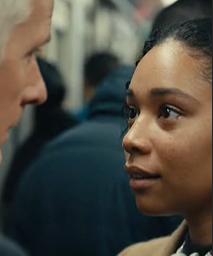
She found a stranger’s wallet on the subway floor — and returned it like any honest person would… But when the man opened it to check, he went pale. Inside was a photo of her mother.
Maya had always believed in doing the right thing, even when no one was watching.
It was a Tuesday morning — the kind that smells like cold coffee and regret — when the 6 train lurched to a stop at 42nd Street and sent half the passengers stumbling into each other. Maya grabbed the pole, steadied herself, and that’s when she saw it: a brown leather wallet, worn at the corners, lying face-down on the grimy subway floor like it had simply given up.
She picked it up without thinking twice.
The man beside her — mid-fifties, silver at his temples, dressed in a charcoal overcoat that had seen better decades — was already patting his coat pockets with the frantic energy of someone who knew exactly what they’d lost.
“Sir,” Maya said, tapping his arm. “I think this is yours.”
The relief that washed over his face was immediate and almost childlike. “Oh, thank God,” he breathed. “Thank you. Seriously, thank you.” He took it from her and flipped it open right there, scanning his cards, his cash — the kind of reflex checking people do when they’ve been burned before.
And then he stopped.
His hands went still. His face drained of color so fast that Maya actually reached out instinctively, afraid he was about to faint.
“Are you okay?” she asked.
He didn’t answer right away. He was staring down at something in the billfold — a photograph, tucked behind a cracked plastic sleeve. Old, slightly faded at the edges. A woman, laughing, standing in front of a lake Maya didn’t recognize.
But she did recognize the woman.
Her heart didn’t just skip — it stopped, rewound, and played back.
“That’s…” Maya’s voice came out barely above a whisper. “That’s my mother.”
The man looked up slowly. His eyes searched her face with an intensity that made her feel like she was standing under a spotlight.
“What did you just say?” he asked, his voice barely holding together.
“That woman.” Maya pointed at the photo with a trembling finger. “In that picture. That’s my mom. That’s Carol Simmons.”
The subway car had become noise and blur around them — doors opening, people shuffling — but neither of them moved. They stood in the center of a universe that had suddenly and irrevocably shifted.
The man swallowed hard. “Carol Simmons,” he repeated, almost like a prayer. “You’re her daughter?”
“Yes. I’m Maya. Maya Simmons.” She paused. “She passed away three years ago.”
Something broke open in his expression. “I know,” he said quietly. “I was at the funeral. In the back. I didn’t think it was my place to introduce myself.”
Maya stared at him. “Who are you?”
He tucked the wallet back into his coat, took a slow breath, and extended his hand. “My name is Daniel Hartley. I was in love with your mother for twenty-two years.” He glanced down, then back up at her. “She never told you about me, did she?”
And the truth was — no. She hadn’t.
Maya had grown up knowing her mother as strong, quiet, and fiercely private. Carol Simmons had raised Maya alone after Maya’s father left when she was four, worked double shifts at the hospital, made every recital and every graduation, and never — not once — had she mentioned a Daniel Hartley.
But standing here now, staring at this stranger holding her mother’s photo in a worn leather wallet he clearly carried everywhere, Maya realized that her mother had been a full, complex, loved human being in ways she had never been allowed to see.
They got off at the next stop together. Neither of them had planned to. They just both stepped off the train like it was the most natural thing in the world, and found a coffee shop two blocks away with sticky menus and good light.
And for three hours, Daniel Hartley told Maya stories about her mother she had never heard.
He told her about how they’d met at a hospital charity event in 1998 — Carol in a blue dress, laughing at something someone else said, and Daniel too nervous to approach her for the first forty-five minutes. He told her about their quiet relationship, how Carol had kept it private not because she was ashamed, but because she had been afraid of how it would look to Maya — a man coming in, potentially disrupting the steady world she’d worked so hard to build for her daughter.
“She always said,” Daniel told Maya, wrapping both hands around his coffee mug, “that you came first. Every single time. No exceptions.”
Maya felt tears sliding down her face before she even realized she was crying.
“She talked about you constantly,” he continued. “Every conversation eventually came back to you. What you were doing, what you wanted to be, how proud she was.” He smiled softly. “She kept that photo of herself in my wallet so she could ‘be there’ when she wasn’t.”
Maya laughed through her tears — the kind of laugh that only comes from grief and love colliding.
When they finally said goodbye outside the coffee shop — exchanging numbers, promising to talk more — Maya stood on the sidewalk for a long moment after he disappeared around the corner.
She looked up at the grey New York sky.
She had walked onto that subway car that morning as a woman still quietly grieving a mother she thought she knew completely.
She walked home knowing something infinitely more beautiful — and more bittersweet — was true: her mother had been deeply, quietly, faithfully loved.
And somehow, even three years gone, Carol Simmons had found a way to make sure her daughter knew it.
Leave a Reply