
She was homeless with his twin babies in October — he had no idea they existed. But a stranger on a park bench changed everything.
The morning Margherita found them, autumn had settled over Riverside Park like a held breath — that particular chill that doesn’t announce itself until it’s already inside your coat.
She came every Tuesday. Thermos of coffee, paper bag of breadcrumbs, the pigeons who expected her. Routine was its own kind of comfort at seventy-three.
She almost didn’t stop.
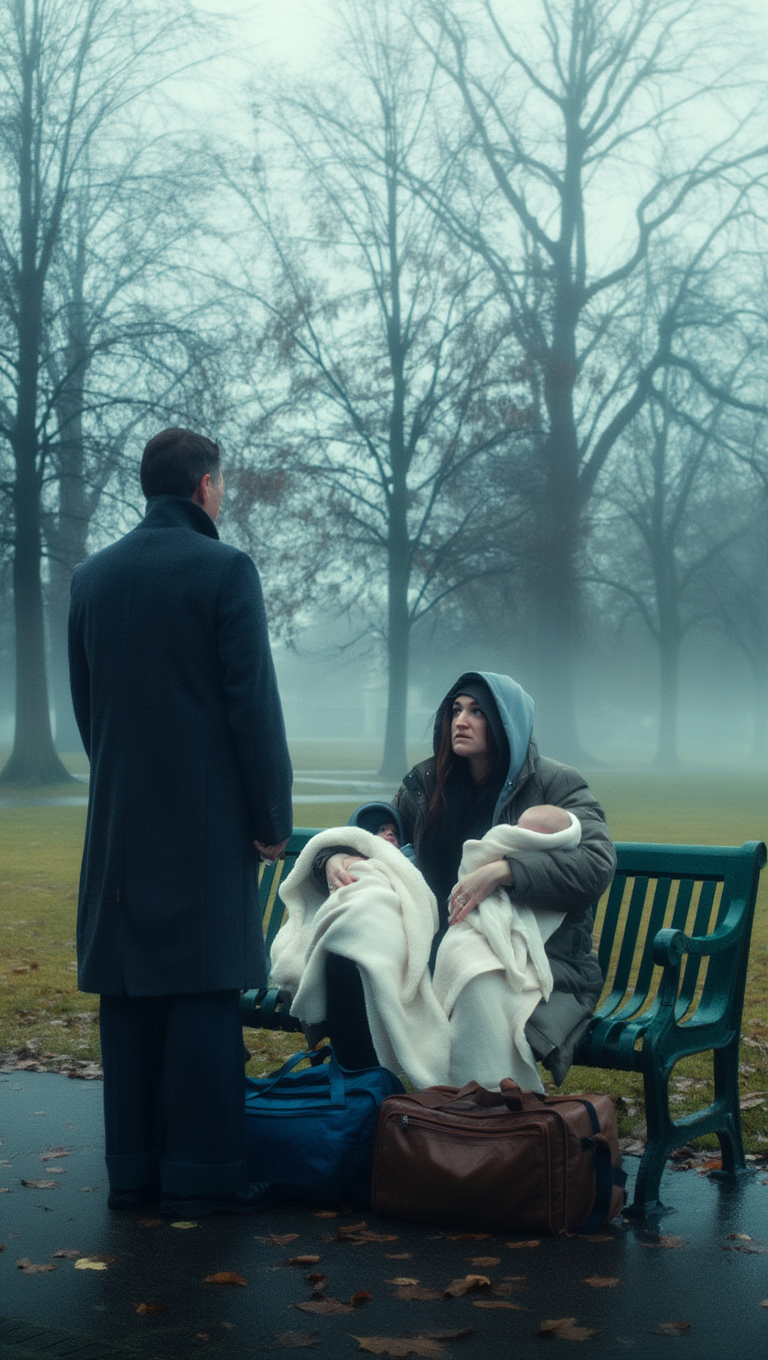
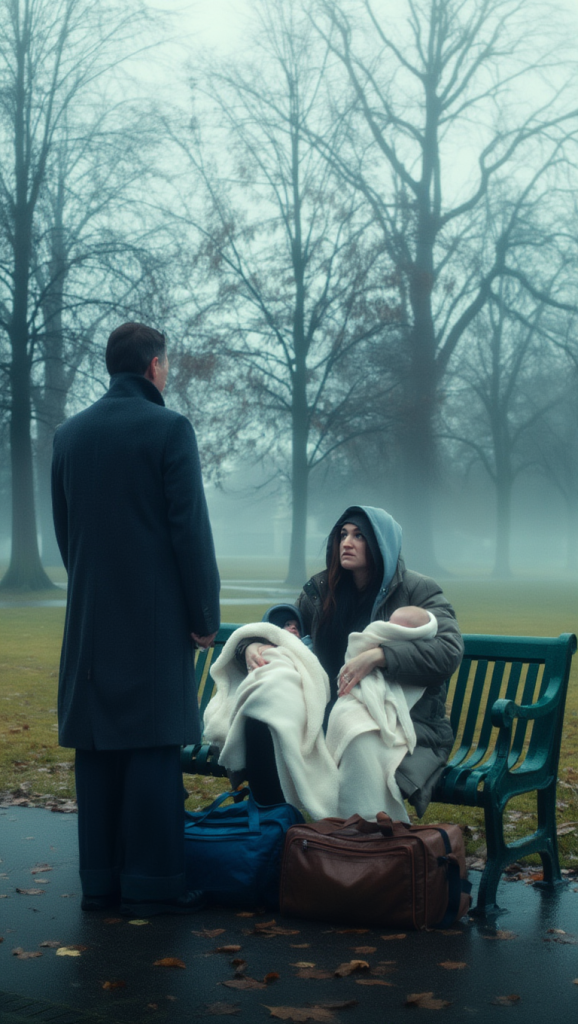
The woman on the bench didn’t look dangerous. She looked demolished — head tilted against the cold iron armrest, eyes shut, two small bundles pressed against her chest like the only warmth left in the world. Margherita slowed. She told herself it was caution.
Then she saw the luggage. Two duffel bags and a cracked plastic crate stacked around the woman’s feet like the walls of a city nobody wanted to enter.
Margherita sat at the far end of the bench. She didn’t speak. She poured herself a coffee and watched the pigeons work the path.
Then one of the bundles made a sound.
A face. Pink, crumpled, furious at the indignity of existing. A baby. The other bundle stirred, releasing a thin, reedy cry that jolted the woman awake with the reflex of someone who had not truly slept in weeks.
“It’s okay, it’s okay.” The words were hollowed out by repetition.
“Boy or girl?” Margherita asked.
The woman’s eyes went wary in an instant. Scanning. Measuring. Then: “Both. A boy and a girl.”
“How old?”
“Three months.”
Margherita tore a crust of bread and threw it to the pigeons. “You have somewhere to be today?”
A long pause. “No.”
“Are you hungry?”
The silence that answered was answer enough.
Her name was Clara. That came out in the second hour, after the coffee, after Margherita had produced a tin of butter cookies from her coat pocket with the calm inevitability of a woman who had spent decades knowing when people needed feeding.
The babies’ names were Leo and Sofia. Those came easier.
“Leo always wants to eat first,” Clara said. “Sofia waits. She just watches you. Like she’s taking notes.”
“Smart girl.”
“Terrifying, actually.” Something softened briefly in Clara’s face — not a smile exactly, but the ghost of one.
Margherita studied the sleeping boy. The line of his jaw. The shape of his nose. The particular way his forehead furrowed even in sleep, as though he was already working on a problem.
Her hands went still.
“What’s your last name?” she asked carefully.
“Why?”
“Humor an old woman.”
“Ferrante,” Clara said. “Was Ferrante. Before that, Greco.”
The thermos settled onto the bench between them.
“Greco,” Margherita repeated.
“My married name.” Clara’s voice went flat. “Doesn’t matter anymore.”
But Margherita had stopped breathing at the normal rhythm. She looked at the infant’s jaw. The forehead. The way he frowned.
“My son’s name is Adriano,” she said quietly. “Adriano Greco.”
The silence that followed was the loudest thing Margherita had heard in years.
Clara went completely still.
“You should go,” she said.
“Clara—”
“Please.” The word cracked at the edges. “I’m not looking for anything from your family. Not from him. We don’t need anything.”
“You’re on a park bench in October with two newborns.”
“We’re fine.”
“You’re not fine.” Margherita’s voice didn’t rise. It simply landed harder. “I’m not saying it to shame you. I’m saying it because I’m a mother, and I can see exactly what this is costing you.”
Clara’s jaw tightened. Her eyes went bright.
“He doesn’t know,” Margherita said. Not a question.
A long silence. “I wrote him a letter,” Clara said finally. “I never sent it.”
“Why?”
“Because I read about the Series C round. The Forbes profile. The keynote.” She laughed — a short, empty sound. “He was busy being important. I didn’t want to be the problem he didn’t plan for.”
“You weren’t a problem.”
“I know what I was to him.” Clara looked down at Sofia, who had opened her dark, focused eyes and was watching her mother with that uncanny attention Clara had already described. “I was a chapter he closed.”
“He was wrong to close it.”
Clara didn’t answer.
Margherita picked up her phone.
“What are you doing?” Clara asked immediately.
“Calling my son.”
“Don’t.” Her voice broke. “Please don’t.”
Margherita looked at her steadily. “He has children sleeping on a park bench. He will know.”
Adriano was in a glass-walled conference room when his phone vibrated. He let it go. It vibrated again. He declined it. On the third call, forty seconds later, he stepped out.
“Come to Riverside Park,” his mother said. “The bench near the east fountain. Right now.”
“I’m in the middle of—”
“Adriano.” Her voice was a frequency he hadn’t heard since he was seventeen and she’d discovered he’d been lying for months. “Right now. Do you understand me?”
He took a car. Twenty minutes. He walked the east path telling himself this was probably nothing, probably one of her moments—
He saw his mother first. Then the woman beside her.
His legs stopped working before his brain could form a coherent thought.
“Clara.” The word came out fractured. Too quiet.
She looked up and every defense she possessed rose at once. Her arms tightened around the child she was holding.
“I didn’t ask for this,” she said.
“I know.” He couldn’t move. “I know you didn’t.”
He looked at the infants. His mother held the boy — Leo — with the practiced ease of sixty years of motherhood. Adriano stared at his son’s face and felt the world he had spent fifteen years constructing — the term sheets, the valuations, the board meetings, the cover stories — suddenly seem to belong to someone else’s biography.
“How long?” he asked.
“Three months.”
“No. How long have you been out here?”
She didn’t answer.
“Clara.”
“Eleven days,” she said.
Something turned cold in his chest and then immediately, scalding hot. “Eleven—”
“We were in a shelter before. There was an incident, the next placement fell through, and I—” She stopped. Straightened her spine. “I handled it.”
“You were sleeping outside in October with two newborns.”
“We had blankets.”
He pressed his fingers to his mouth. Whatever he said next would be wrong. He could feel that clearly.
“Why didn’t you call me?”
“Why would I?”
“Because they’re mine.” The words came out raw. “Because you were struggling and I was just—”
“Building your empire,” she said. Quietly. Without cruelty. Which was somehow worse than cruelty.
“I didn’t know.”
“I know you didn’t.” She looked at Sofia. “That’s not the same thing as it not happening.”
Margherita was already standing, Leo against her shoulder, in the tone that had ended arguments since 1987. “We’re going to the car.”
“I can’t just—” Clara began.
“You can and you will. Not for him. For them. They need warmth and a doctor and you need a bed, and none of that is weakness, Clara. None of it.”
Clara looked at this woman she’d met two hours ago and felt something crack open slightly in her chest. Not trust. Not yet. But the possibility of it.
“I’m not moving in with him,” she said.
“No one said you were.”
“I’m not doing this because I want anything from him.”
“I know,” Margherita said gently. “You’re doing it for Leo and Sofia. That’s the only reason that matters.”
Clara stood slowly, carefully, the way you move when everything hurts but you refuse to show it.
Adriano reached down and picked up both duffel bags before she could.
She looked at him. He didn’t speak. He just carried them.
The house was too large and too quiet. Five bedrooms. A kitchen that appeared to have been used perhaps four times. Views of the river.
He showed her the room at the end of the hall, the adjacent room, the bathroom, the towels, the drawer with extra blankets. He spoke in the careful, controlled voice Clara recognized — the voice he used when he was holding himself very still on the inside.
“Adriano.”
He stopped.
“This doesn’t mean anything,” she said. “Between us. This is for them.”
“I know,” he said.
“I need you to actually know that. Not just say it.”
He turned to face her fully. The boardroom polish was gone. He looked tired. He looked like the man she had married, back when he was still occasionally just a person.
“I walked out on you,” he said. “I had reasons and they were all garbage. I’m not going to try to explain or ask for forgiveness. I just want to be present. For them. And for whatever you need, practically. That’s it.”
She studied him for a long moment.
“Okay,” she said. “We’ll see.”
A doctor came the next morning — Margherita had arranged it before anyone woke. Leo and Sofia were healthy, slightly underweight. Clara was dehydrated and fighting a respiratory infection that had been spreading quietly for two weeks.
“She needs real rest,” the doctor told Adriano in the hallway. “A week minimum.”
Adriano called his assistant and cleared his calendar for ten days.
The first diaper change took him eleven minutes. Leo stared up at him throughout with an expression of profound skepticism that seemed entirely warranted.
“I know,” Adriano told him. “I have no idea what I’m doing.”
Leo sneezed.
“That’s fair,” Adriano said.
He got the new diaper on wrong twice. The third time it held. He lifted Leo and stood at the window watching the river, and felt something shift in his chest — some weight he had carried so long he’d stopped noticing it.
He hadn’t known he was lonely until he stood here holding his son.
Clara watched from the doorway. He was singing — quietly, slightly off-key, some old song she vaguely recognized. She had spent eleven days in the cold telling herself she didn’t need him. That the children didn’t need him. That they would figure it out.
She had believed it. She’d had to.
Watching him now, she didn’t stop believing it exactly. But she let herself consider that maybe there was a version of this that didn’t have to be as hard.
She stepped back before he saw her.
Month three. The conversation happened on a Sunday, the first genuinely warm day of the season, windows open, Sofia in her bouncer fascinated by felt stars, Leo asleep.
“I talked to a housing advisor,” Clara said. “There are options. I’m eligible for a relocation subsidy. I have experience in nonprofit admin. I’m building a plan. I’m not dependent on you.”
“I know you’re not.”
“Good.” A pause. “Because I need you to understand that what I’m about to say comes from strength. Not from needing you.” She held his eyes. “I want to try. Not the way it was before. Something different. Slower. With actual honesty.”
The room was very quiet.
“I want that too,” he said. “I’ve wanted it since the first day.”
“You don’t get to just want it. You have to earn it.”
“I know.”
“Every day.”
“I know.” He looked at her. “I’m not going anywhere.”
She held his gaze — measuring, weighing, all the wariness of the past months still present in her eyes. But something else now too. Something cautious and real and alive.
“Okay,” she said. “Day by day.”
“Day by day,” he agreed.
One year later. The park was gold and warm — the same trees, the same fountain, but October had given way to a long late summer that showed no interest in ending.
They walked the four of them. Adriano and Clara, the double stroller between them, Margherita slightly ahead because she walked faster than everyone and refused to apologize for it.
Clara stopped at the bench.
Just a bench. Green paint, worn slats, a pigeon on the backrest staring at them with perfect indifference.
“You okay?” Adriano asked.
“Yeah.” She looked at the bench. Then at the stroller. Then at him. “I was so angry that day. When your mother called you. I’d been holding everything together for so long and I was so close to finding a way through on my own, and then she made that call and it felt like—”
“Like it was taken out of your hands.”
“Yes.” She exhaled. “And now I’m glad.”
He reached over and took her hand. She let him.
Margherita turned around. “Are you two being slow and emotional in the middle of the path?”
“Yes,” Clara said.
“Fine.” Margherita sat down on the bench. She crossed her ankles. She looked at the pigeons. “Take your time.”
Leo opened his eyes in the stroller — dark, watchful, already too serious for a one-year-old. He found his father’s face.
He smiled.
Adriano stood on the path in the warm October light, holding his wife’s hand, watching his son smile at him, and felt — for the first time in a very long time, maybe for the first time ever — that he was exactly where he was supposed to be.
Not ahead of himself. Not behind.
Right here.
The empire could wait.
Leave a Reply