
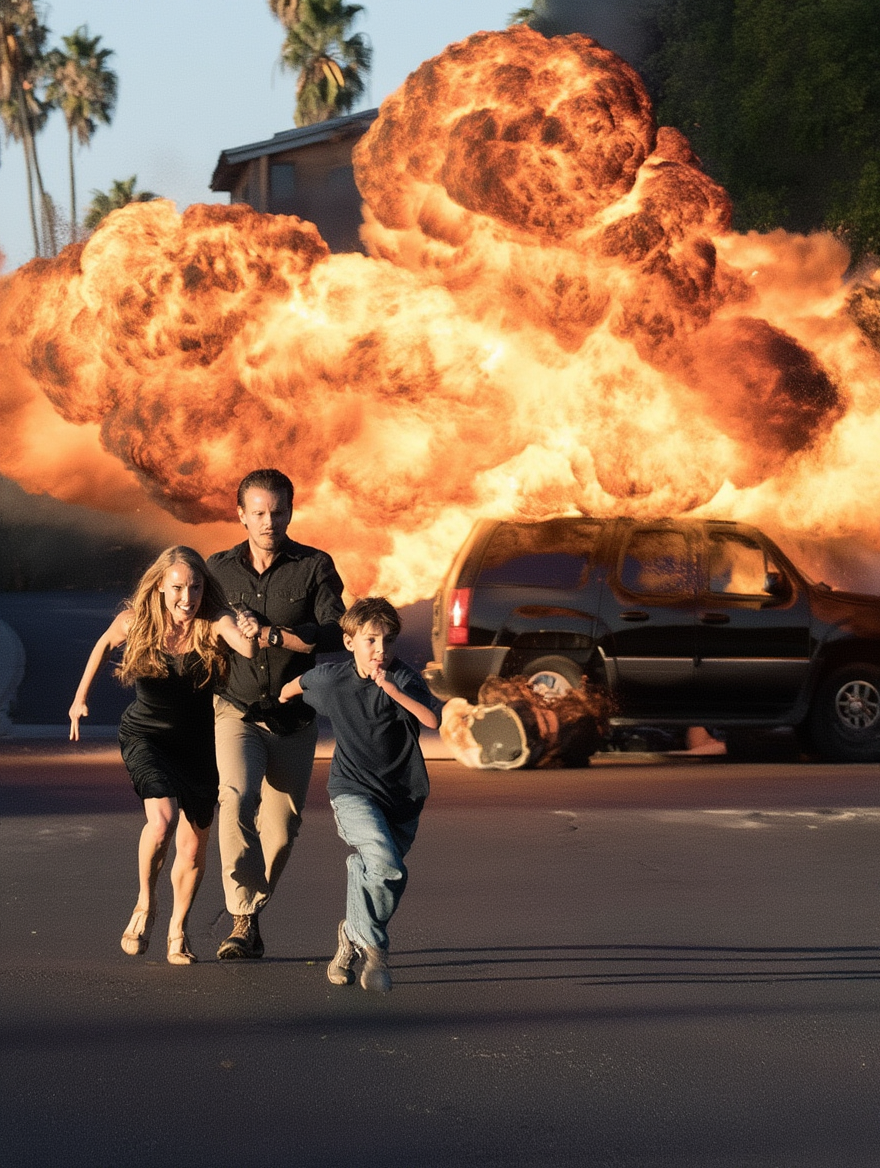
My husband slammed the car onto the highway shoulder and screamed “Get Out!” — I thought he’d lost his mind. Fifteen seconds later, our SUV was engulfed in flames.
We had been on the road for exactly ten minutes when my husband Aaron became someone I didn’t recognize.
A moment before, everything was perfectly ordinary. Mason, our four-year-old, was in the back seat negotiating which of his seven stuffed animals deserved window privileges. I was scrolling through the playlist for the drive. Aaron was doing what Aaron always does — both hands on the wheel, mirrors checked, following the GPS like a co-pilot logging a flight plan. He’s an engineer. The kind of man who labels batteries in the emergency kit and checks tire pressure the morning of a long drive. In fourteen years together, I had never once seen panic on his face.
And then I did.
His jaw tightened. His knuckles went white on the wheel. His eyes fixed on the dashboard with an expression so foreign on him that my stomach dropped before I even understood why.
“Aaron—”
The car lurched violently to the right. Gravel exploded beneath the tires. My shoulder slammed into the passenger window hard enough to blur my vision.
“Out of the car!” he shouted. “Now — everybody out!”
Before I could speak, his hands were already moving. Unclipping my seatbelt. Reaching into the back seat. Tearing open Mason’s car seat harness with shaking fingers.
Mason immediately burst into tears, that high, panicked cry that only comes when children sense something is truly wrong.
“Daddy, I’m scared!”
“I know, buddy. I know.” Aaron’s voice was barely controlled. “But you have to come with me right now.”
He scooped Mason with one arm, seized my wrist with the other, and pulled us away from the car at a near-run — down the small embankment beside the highway, onto uneven ground. I tried once to resist, to stop and ask the question building in my chest. But the look on his face wasn’t hysteria. It wasn’t confusion. It was dread. The specific dread of someone trying to outrun something they’ve already calculated.
We were fifteen yards away when it happened.
A sharp metallic crack rang out from beneath the vehicle — like a steel cable snapping under impossible tension. Then the front of the SUV dropped to one side. And then the fire came. Not smoke first. No warning hiss or slow gathering of heat. Just fire — sudden, bright orange, erupting from beneath the engine compartment with a force that pushed a wave of heat across our faces even from that distance.
I could not move.
Mason buried his face in Aaron’s neck, sobbing. Cars in the passing lane began braking. Someone leaned on a horn. The sound of shattering glass reached us as a second explosion popped from under the hood, and safety glass scattered like ice across the highway asphalt.
I stood there watching our three-day trip burn. The suitcases visible through the rear window. The snack bag still propped in the cup holder. The ordinary wreckage of a normal family morning, lit up like a warning flare on a stretch of interstate that was, ten minutes ago, nothing more than the beginning of a drive.
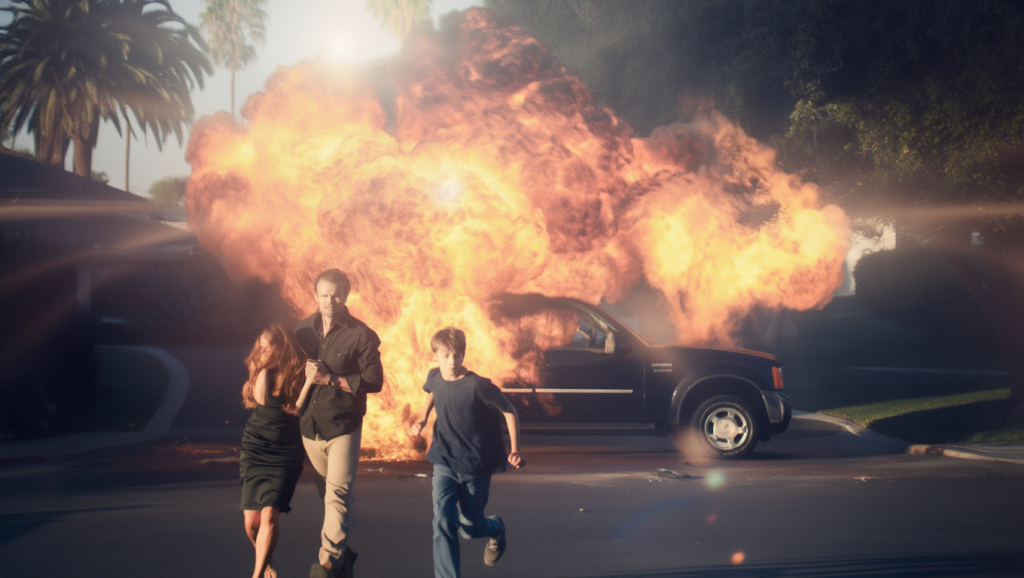
A truck stopped ahead of us. Two strangers jogged toward the guardrail. One was already calling 911.
Aaron was breathing in short, controlled bursts, still clutching Mason. I turned to him and asked the only question that made sense.
“How did you know?”
He didn’t answer immediately. His eyes stayed fixed on the fire.
Then, quietly, barely above the sound of the distant sirens, he said: “Because that wasn’t an accident.”
I was certain I’d misheard him.
But his face told me I hadn’t.
This is what he hadn’t told me:
That morning, while loading the cooler into the trunk, Aaron had dropped his house keys. They slid beneath the passenger side of the car. When he crouched down to retrieve them, he saw something that didn’t belong. A small black device, strapped to the undercarriage near the front axle. He hadn’t been able to see it clearly. He told himself it was road debris, a loose aftermarket part, something that belonged there and he simply didn’t recognize. He didn’t want to frighten me before the trip. He planned to stop at the first gas station with good lighting and take a proper look.
But ten minutes onto the highway, a chemical smell reached him. And then the temperature gauge began jumping — climbing, dropping, spiking again in a pattern that meant only one thing to an engineer who understood what was happening beneath the vehicle.
He had perhaps thirty seconds to decide.
He used them to get us out.
The state trooper arrived before the fire was fully extinguished. A fire investigator followed. Aaron gave his account in short, precise sentences while I stood with Mason, whose crying had reduced to soft, confused hiccups against my shoulder. I answered the officer’s questions automatically, still suspended somewhere between the world where we were fine and the world where I had just watched our car burn on the side of a highway.
Then the detective asked the question that rearranged everything.
“Did anyone know your travel plans?”
I answered immediately. Family. A few close friends. My sister, who had stopped by the previous afternoon to drop off a birthday gift for Mason and had seen the car already packed in the driveway.
The detective wrote that down.
And a new, colder understanding moved through me.
Because if someone had known when we were leaving — if they had waited for the morning of the trip — they hadn’t simply targeted Aaron.
They had waited until all three of us were inside the car.
That evening, the detective called.
The fire had not been mechanical. Investigators had recovered fragments of an incendiary device — crude, not sophisticated, built to ignite when road vibration and engine heat reached a certain threshold. The crudeness of it, the detective explained carefully, wasn’t reassuring. Crude devices built in rage are unpredictable. They don’t always behave the way their builders intend.
This was attempted murder.
I sat on the edge of the hotel bed while Mason slept and Aaron finally told me the rest.
Two weeks earlier, he had testified in a civil lawsuit against a construction company he once consulted for. The company had falsified safety inspection reports. A parking structure had partially collapsed. People had been hurt. Aaron had found inconsistencies in the engineering documents and refused to sign off on revised reports. Then he handed over emails proving the supervisors had known about the structural defects before the collapse.
After that, a car sat outside our home twice in one week. Two calls came from blocked numbers. One night our side gate was found open.
Aaron had minimized all of it. Told me it was intimidation. Bluster. Men trying to frighten him into silence.
Three days before our trip, a project manager named Victor Hale had approached Aaron in his office parking garage. He hadn’t threatened him directly — careful men rarely do. He had simply stepped too close and said: You should think harder about what accidents do to families.
Aaron had reported it to the legal team. They documented it. They told him not to engage.
He hadn’t told me because he didn’t want to ruin the trip. Because he didn’t want me to be afraid. Because he had convinced himself that none of them would actually go near us.
That’s when I cried.
Not loudly — Mason was sleeping three feet away. But the quiet, shaking kind of grief that arrives when you understand, in full, how close you came to losing everything. I cried for Mason screaming on the roadside. For the fire reflected in the side mirror. For the fifteen seconds that stood between our ordinary morning and the end of us. And for the weight Aaron had tried to carry alone, believing that protecting me from fear was the same as protecting me from danger.
Victor Hale was arrested four days later.
People acting from rage tend to make mistakes. Security footage near our neighborhood showed a rental truck following Aaron home the night before our trip. A receipt linked materials in the device to a purchase made on a card belonging to Victor’s cousin. Phone records and toll data filled in the rest. Under questioning, the cousin said Victor had only wanted to scare Aaron — to push him into withdrawing his testimony.
Whether Victor intended fear or death no longer mattered.
He had strapped fire beneath a car with a child in the back seat.
We took another road trip eventually. Months later. The first time Aaron turned the key in a new car, my throat closed. The first time Mason asked from the back seat — this car is safe, right, Daddy? — I had to look out the window before answering.
Surviving something like that doesn’t erase the fear. It just teaches you how quickly everything you rely on can become something else entirely. How little space exists between before and after.
But it also shows you what holds.
Aaron noticed something wrong and trusted what he knew. He made a decision in thirty seconds that saved three lives. And because of those seconds — those frantic, gravel-scattering, tire-shrieking seconds on the shoulder of a highway — Mason is still here. Still negotiating about stuffed animals. Still falling asleep holding juice boxes he never finishes. Still asking questions from the back seat on ordinary mornings that are, when you have lived through the alternative, the most extraordinary thing in the world.
Leave a Reply