
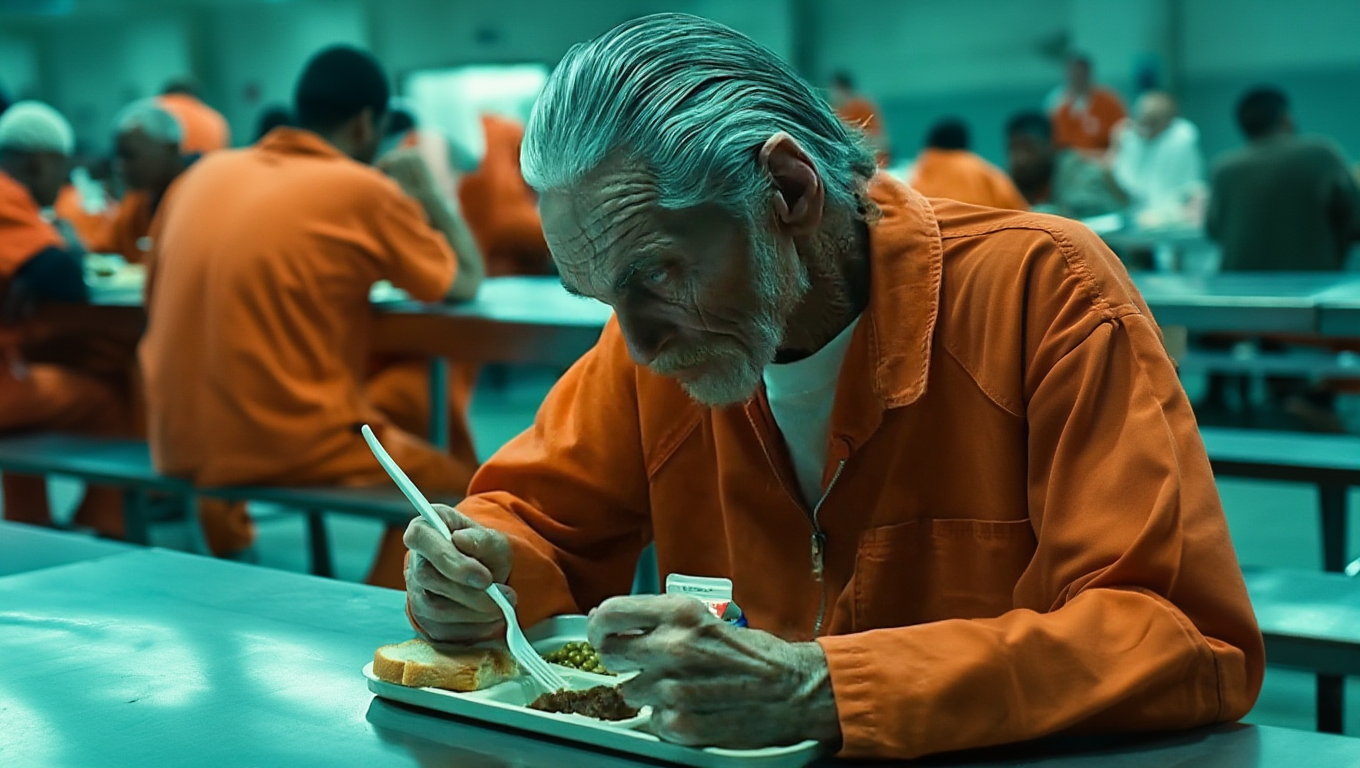
A 60-year-old man sat alone in a prison cafeteria when the most feared inmate flipped his tray… and simply said, “You just made a big mistake.” But instead of fighting back, he stood up, turned around, and walked away.
The noise inside the cafeteria was constant, but never chaotic. It was controlled—the way everything in prison had to be. Metal trays scraped against steel tables. Boots thudded on concrete. Low conversations blended into a dull, mechanical hum beneath the flicker of fluorescent lights that buzzed like they were always on the edge of dying.
No one laughed here. Not really.
In the far corner of the room—away from the gang clusters, away from the invisible territorial lines that divided the space like invisible fences—an old man sat alone.
His name was Walter Hayes.
Most inmates didn’t know much about him. Some said he’d been inside longer than anyone else on the block. Others whispered that he’d once been someone important on the outside. Military, maybe. Intelligence. Or something worse that didn’t have a clean name.

But in a place where every man carried a past, asking questions was a luxury you couldn’t afford.
Walter didn’t invite questions anyway.
He ate slowly. Deliberately. As if time belonged to him and no one else. His hands were steady despite the years written across them—thin skin, old knuckles, the quiet record of a life that had demanded a great deal. His gray hair was cropped short. His beard trimmed just enough to avoid notice. But his eyes—
His eyes were the thing people remembered, even if they couldn’t explain why.
Cold. Observant. Patient.
The kind of eyes that never flinched. That didn’t react—but recorded everything, filed it, and waited.
That afternoon, tension moved through the cafeteria like a current nobody could see but everyone could feel. A new inmate had arrived the previous day, and the news had already moved through every cell block the way news always did in prison—fast, quiet, and impossible to stop.
Big. Violent. Unpredictable.
His name was Marcus Kane.
Marcus didn’t walk into rooms. He took them.
The cafeteria doors slammed open and the ambient noise dipped—not to silence, but to a collective, involuntary awareness. Marcus stepped in like he owned the square footage. Six feet of muscle straining against his orange uniform. Tattoos crawling up his neck and across his arms in dark, jagged patterns that didn’t need translation. Behind him, two smaller inmates followed at a respectful distance, laughing at something he’d said—though it wasn’t clear if they found it funny or were simply performing loyalty.
Marcus scanned the room.
He didn’t move toward the biggest group. He didn’t target a rival with history.
He picked Walter.
Because Walter looked like nothing.
Old. Alone. Quiet.
Easy.
Marcus moved across the cafeteria, his boots hitting the floor with a rhythm that parted attention the way a stone parts water. A few heads turned. Inmates who had been in long enough watched without appearing to watch—that specific prison skill.
Walter didn’t look up.
He kept eating.
Marcus stopped at his table. A moment passed—the kind that stretches. The air in the room pulled tight.
Then—
BANG.
Marcus’s hand came down on the metal tray with the full force of someone who wanted the sound to carry. The tray flipped violently. Food scattered across the concrete—mashed potatoes smearing the floor, bread sliding under the bench, the overcooked meat landing in a heap.
The cafeteria went quieter than it had been in hours.
Marcus smirked, leaning forward just slightly. “Oops,” he said, low and deliberate.
Walter didn’t react.
He simply looked at the empty space where his tray had been. One second passed. Two.
Then, slowly—unhurried—he lifted his head.
Their eyes met.
And for a fraction of a second, something changed in Marcus’s face. The smirk didn’t disappear, but it hesitated. Because what he found in the old man’s gaze didn’t match the situation. There was no fear. No anger threatening to spill over.
Just control.
Walter’s mouth curved—not into a smile, but something colder. Sharper.
“You just made a big mistake,” he said.
The words came out calm. Deep. Certain. Not loud—but the kind of voice that didn’t need volume to carry across a room.
One of Marcus’s men let out a nervous laugh, trying to dissolve the moment. Marcus straightened, rolling his shoulders, recalibrating.
“Yeah?” he said, louder now, playing to the room. “And what exactly are you gonna do about it, old man?”
Walter didn’t answer.
He held the eye contact for one more beat—then stood. Slowly. No sudden movement. No theater.
And he walked away.
That was it. No fight. No threats traded back and forth. No escalation.
Just walked away.
The cafeteria noise crept back gradually, though something had shifted underneath it. Conversations were quieter. Eyes followed Walter until he was gone. Marcus laughed loudly, trying to reclaim the air.
“That’s what I thought.”
But the laugh didn’t land right.
Even his own crew barely responded.
Because something about the moment didn’t feel finished.
That night, darkness settled over the prison the way it always did—not as an absence of light, but as a presence. Every sound traveled further. Every shadow went deeper.
Marcus lay on his bunk, staring at the ceiling.
He told himself he wasn’t worried.
He was almost right.
But the old man’s face kept returning—that stillness, that cold curve of a mouth that wasn’t quite a smile. It didn’t match the script Marcus had written for his first week. People reacted to him. They feared him, avoided him, tried to get on his side before the wrong side found them first.
They didn’t warn him.
Marcus sat up in the dark, annoyed at himself for letting it occupy space in his head.
“Forget it,” he muttered.
Just some old man. Nothing more.
In another cell block, Walter sat on the edge of his bed. Hands resting on his knees. Eyes open in the dark.
Still.
Waiting.
Around midnight, the lights flickered once—routine enough. But tonight they held just a half-second longer than usual.
Just enough.
A guard made his scheduled rounds. Keys jingling. Boots landing in their predictable rhythm. Walter had learned that rhythm months ago. He stood as the footsteps approached his door.
And passed.
He counted.
One. Two. Three.
Then he stepped out.
Marcus woke to a sound.
Soft. Metal. Close.
His eyes adjusted to the dark slowly—and then he saw it.
A figure.
Standing near the bars.
Still.
Watching.
Marcus sat up fast. “Who the hell—”
“Shhh.”
Calm. Familiar.
Walter stepped slightly into the thin edge of light that filtered through the bars.
Marcus’s confusion overrode his aggression for just a moment. “How did you—”
The cell door clicked.
Unlocked from the inside of an already-locked system.
Marcus went still. That wasn’t possible.
Walter stepped in. Slow. Controlled. He closed the door behind him and the click that followed seemed to echo longer than it should have.
Marcus rose to his feet, every muscle in his body tightening. Even now, towering over the old man, something at the base of his instincts sent a signal he didn’t fully understand.
“You got nerve,” Marcus said. “I’ll give you that.”
Walter didn’t respond.
Marcus moved first—fast and aggressive, the way he always moved, the way that had never failed him.
But Walter wasn’t where he expected him to be.
He moved like something efficient. Something practiced. He stepped aside, redirected the momentum with minimal effort, and Marcus hit the wall with more force than he’d intended to generate himself.
Before he could recover—
Walter struck.
Not wildly. Not fueled by anger or adrenaline.
Every movement had a purpose.
A precise strike to the ribs. A shift in balance that shouldn’t have been possible from someone his age. Another hit—controlled, deliberate—landing exactly where it was meant to land.
Marcus fought back hard, but something was consistently wrong. The old man wasn’t reacting to him. He was anticipating—moving before the strike came, already somewhere else by the time the swing arrived.
It ended the way it began.
Quietly.
Marcus was on the floor, chest heaving, mind struggling to locate the sequence of events that had brought him there.
Walter stood over him. Not proud. Not angry.
Just finished.
He crouched slightly, meeting Marcus’s eyes in the dark.
“You weren’t punished for the tray,” he said.
Marcus blinked.
“You were punished for thinking there wouldn’t be consequences.”
Walter stood. Opened the cell door.
And walked out.
By morning, the story had already moved through the prison—not through announcements or official reports. Through whispers. Through looks exchanged across tables. Through the specific silence that falls when everyone in a room knows something that no one will say out loud.
Marcus didn’t speak about it.
He didn’t have to.
Because when he walked into the cafeteria that morning, he moved differently than the day before. Still large. Still marked. But something behind his eyes had been quietly rearranged.
He got his tray.
He found a table.
And he chose it carefully.
Nowhere near the far corner.
Nowhere near the old man who sat there quietly, eating his lunch with steady hands and patient eyes—
Like nothing had happened.
Like everything had.
Leave a Reply