
A maid heard scratching inside a sealed coffin at a funeral… and no one believed her. So she grabbed an axe.
The funeral had been arranged too quickly.
That was the first thing people said afterward — that it had all happened so fast. The obituary. The flowers. The closed casket. The older man at the front of the room, grief-stricken in the way powerful men perform grief: jaw tight, eyes dry, hand resting on the polished lid as though he owned both the coffin and what was inside it.
He did, in a way. That was the horror of it.
The maid hadn’t planned to make a scene. She’d simply come to lay the flowers, same as always. But when she pressed close to the casket to arrange the lilies, she heard it — a sound so small and desperate that her whole body went cold.
Scratching.
She stepped back. Looked around. No one had noticed. The mourners were murmuring quietly in black clusters. The older man was receiving condolences near the door.
She leaned close again.
Three slow, weak scratches. Then silence. Then a barely audible knock — the knock of someone who has almost stopped hoping.
“There’s someone in there,” she said.
Everyone looked at her. No one moved.
“There’s someone alive in there.”
The older man turned from across the room. His expression didn’t break into confusion or disbelief. It broke into something else — something controlled and cold — and that was when the maid knew.
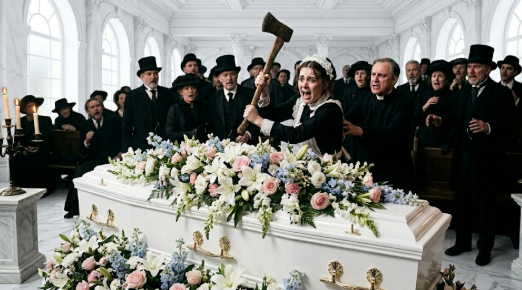
She didn’t ask again. She found the axe near the maintenance closet, the one used to split the wooden displays during setup, and she walked straight back to the casket.
The crack of the lid split the silence of the room like a gunshot.
A hand came through first.
And that was when everything changed — because the hand wore a ring. A heavy signet ring, engraved with a family crest every single person in that room recognized. Not because it belonged to the woman in the coffin.
Because it belonged to him.
The older man went rigid.
Two mourners rushed forward and pulled the damaged lid aside. Inside lay Emily — pale, dazed, ragged breath barely moving her chest, wrists bruised from where she’d fought against ribbon and fabric in the dark. Her eyes opened in confusion, then terror, then found his face like a compass finding north.
The room had never been so quiet.
She didn’t need to explain the ring. Its presence on her wrist said everything: a final claim. A parting gesture dressed as sentiment. He had placed it there himself, or had someone do it for him, as if the dead could be branded before being forgotten.
Her hand trembled as she ripped it free and threw it at his chest.
It hit his jacket and dropped to the polished floor.
That small sound was somehow louder than the axe.
“What did you do?” someone whispered.
Emily’s voice came out broken but clear.
“He said it would be easier if they thought I was gone.” She forced another breath. “He said I knew too much.”
She had. She’d found the documents three weeks earlier — transfers, falsified trust accounts, signatures that shouldn’t exist. Years of estate money quietly redirected, hidden behind dead accounts and complicated legal language designed to outlast the people who might notice. She had confronted him. Given him a chance to confess before the reading of the will.
His solution had been elegant, in the way only cruelty can be elegant: don’t kill her. Make her disappear in a way everyone will mourn too quickly to question. A sudden illness. A closed casket. A rushed goodbye.
He’d told the family not to open it. Told them it was better to remember her as she was.
The maid looked at him now with something colder than hatred.
“You put your ring on her wrist because you thought dead women can’t speak.”
No one in the room moved toward him. No one defended him. They were all remembering — the rushed preparations, the insistence on a closed lid, the grief that had somehow always pointed away from any question worth asking.
Emily was helped upright by one of the women in mourning, who held her carefully, as though she might shatter. She didn’t shatter.
She sat in the wreckage of her own coffin and looked at the man who had put her there, and she did not look away.
The older man opened his mouth.
But the ring was already on the floor.
And Emily was already alive.
And the maid was still holding the axe.
Some things cannot be unsaid by the person who did them. They can only be witnessed — by a room full of people who will remember, by a woman who survived, by one ordinary person who heard a sound no one else wanted to hear and decided that it mattered.
The funeral did not end in mourning.
It ended in testimony.
Leave a Reply