
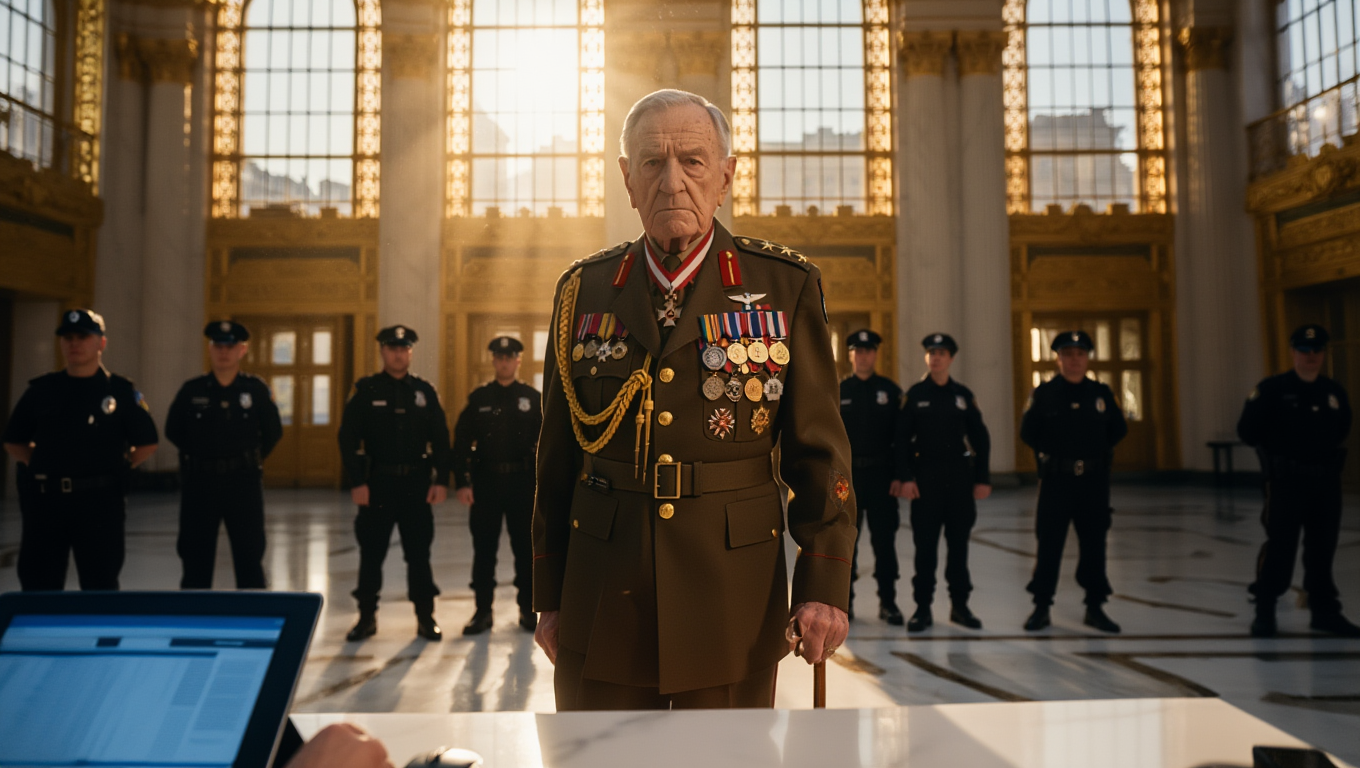
A 70-year-old veteran slammed his black card on a luxury bank counter and screamed at the president… But when the president finally checked the balance, his hands started shaking.
The marble lobby of Hargrove Private Bank gleamed under crystal chandeliers. Everything here was deliberate — the hushed voices, the gold fixtures, the way tellers smiled without showing their teeth. This was a place where wealth didn’t speak. It whispered.
Until Walter Briggs walked in.
He moved slowly, the rubber tip of his oak cane tapping against the polished floor like a metronome. His military coat was immaculate — pressed edges, worn medals catching the light. His hands were steady but old, the kind of hands that had built things and broken things with equal purpose. He stopped at the nearest teller window.
“I need you to check my account balance.” His voice was unhurried. Quiet, even.
The young teller, Janet, looked up with the practiced smile they all wore. “Of course, sir. Do you have your card?”
Walter placed it on the counter. Not dropped — placed. Deliberately. A matte black card with no logo. No name on the face. Just a raised serial number and a chip that caught the light wrong, like obsidian.
Janet stared at it for a half second too long. “One moment, sir. I’ll need a manager’s authorization for this card tier.”
From across the lobby, Charles Hayes — president of Hargrove, third generation, bespoke suit — had already been watching. He had a talent for identifying people who didn’t belong. He walked over with his chin slightly raised, radiating the polite contempt of someone who had never once been told no.
“Is there a problem here?”
“No problem,” Walter said, not turning. “Just checking my balance.”
Charles looked at the card. Something flickered across his face — but he suppressed it quickly, replacing it with a smile like a paper cut. “Sir, this branch may not be the right fit for your… needs. Perhaps a community bank—”
Walter finally turned. His eyes were flat and still, like a lake in December.
“You have three seconds to put that card in your terminal,” he said, “before I make a call that changes your entire afternoon.”
The lobby had gone quiet. Phones appeared. Charles felt the weight of the room and made the only calculation available to a man like him: humiliate the old veteran publicly and take the win.
He took the card. He smiled wider. “Of course. Let’s just put this to rest.”
He walked to the main terminal behind the counter — the one that processed legacy accounts — and slid the card through with a theatrical slow drag.
He typed the access code.
He waited.
The screen loaded.
And then Charles Hayes stopped moving.
His fingers hovered over the keyboard like they’d forgotten what they were for. He typed again, slowly this time. A verification prompt appeared. He entered his override credentials. The screen refreshed.
His face had turned the color of old wax.
Janet leaned forward without meaning to. “Mr. Hayes?”
Charles didn’t answer. His eyes were moving across the screen in small, rapid jumps, the way eyes move when the brain refuses to process what they’re seeing. He typed a third time. A fourth. Each keystroke more deliberate, more desperate.
The room held its breath.
Walter tapped his cane once on the marble. “And?”
Charles looked up. For the first time in perhaps twenty years, he had no script. No smile. His voice came out barely above a whisper.
“This account,” he said slowly, “controls our parent holding company.”
A sound moved through the lobby — not words, just air. Stunned, collective exhale.
Walter straightened his medals with one hand. He didn’t smile. He didn’t gloat. He simply picked up the black card from the terminal, slid it into his breast pocket, and said:
“I served thirty-one years so people like you could stand in places like this. The least you can do is check a balance when asked.”
He turned and walked toward the door, cane tapping a slow, steady rhythm.
Nobody stopped him. Nobody spoke. Charles Hayes stood motionless at the terminal, the screen still glowing with a number that had rearranged everything he thought he knew about the lobby, the bank, and the quiet old man who had just walked out of it.
Leave a Reply