
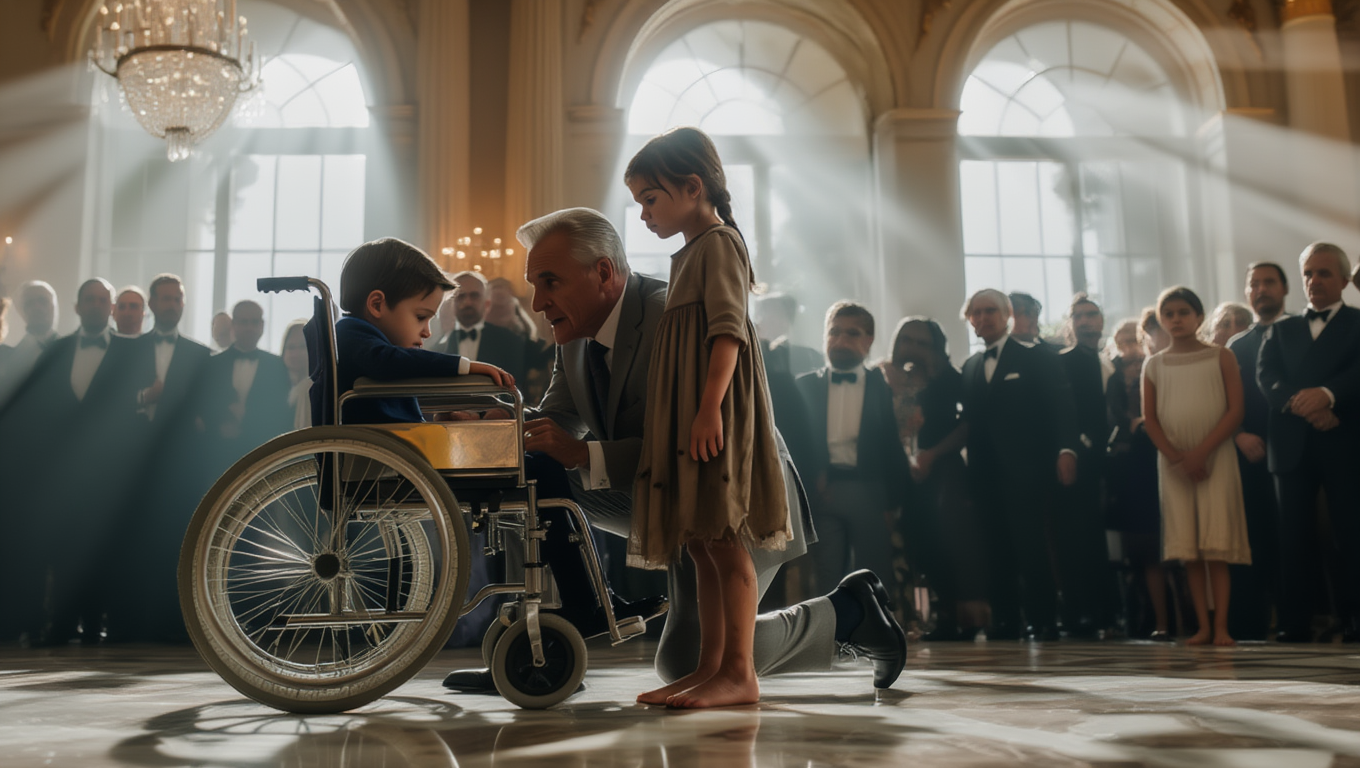
A barefoot orphan girl walked into a palace ballroom full of millionaires — grabbed a disabled boy’s hand and whispered: “I can make you walk.” The boy’s guardian dropped to his knees and wept…
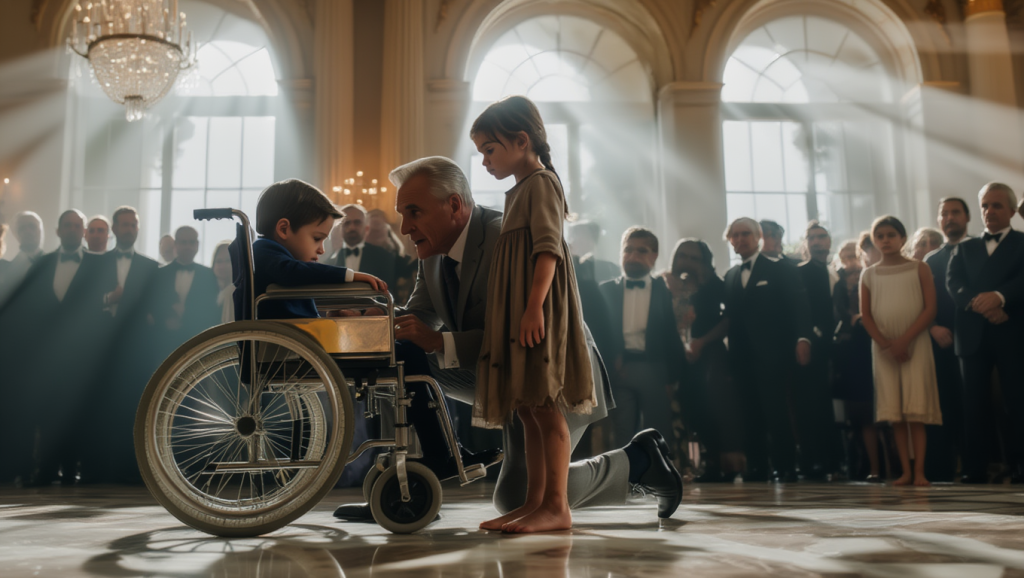
The invitation had been a mistake. Everyone in the Golden Ballroom knew it the moment she appeared in the doorway.
She couldn’t have been older than seven. Barefoot, dress in tatters, brown hair matted against her dirt-smudged face. The crystal chandeliers above her cast light on the hundreds of thousands of dollars worth of silk and jewelry worn by the guests — and then on her. The contrast was almost violent.
No one moved to stop her. Perhaps they assumed she belonged to one of the staff. Perhaps they were simply too stunned.
She walked with purpose. Not the hesitant shuffle of a lost child — but the quiet, deliberate steps of someone who knew exactly where they were going. And she was going toward the boy in the wheelchair.
His name was Elliott. Eight years old, son of Richard Hargrove — one of the wealthiest men in the country. Elliott had not walked in three years. The doctors had given explanations. Long words, cold offices, sympathetic eyes. Richard had given everything — specialists, surgeries, experimental treatments. Nothing had worked. And slowly, Elliott had stopped hoping. He sat in his navy suit, watching the party around him with the hollow eyes of a child who had learned too early that some things cannot be fixed.
Then the girl appeared before him.
She reached out and took his hand.
The room noticed. Conversations died mid-sentence. Champagne glasses paused halfway to lips.
“Leave with me,” she said.
Richard was at her side in three strides. “Get away from him,” he said, his voice low and sharp. “This isn’t a joke.”
The girl did not let go of Elliott’s hand. She turned to the boy as if his father had not spoken at all.
“I can make you walk,” she said. “I know what he forgot.”
The sentence landed like a stone dropped into still water. Richard’s hand — reaching for the girl’s shoulder — stopped in mid-air.
“What did you say?” he whispered.
She looked at Elliott with eyes that seemed too old for her face, too steady, too certain.
“The last time he stood up,” she said softly. “You remember, don’t you? The morning after the storm. You stood up alone. Just for a second. And you looked out the window and you saw the garden. And you didn’t tell anyone — because you were afraid it wasn’t real.”
The ballroom had gone completely silent.
Elliott’s breath caught in his throat. His fingers tightened around the girl’s hand. Because she was right. He had never told a single person. Not his father. Not his doctors. Not anyone. One morning, three months ago — half asleep, half dreaming — he had stood. Just for a moment. Just long enough to see the roses in the garden through the foggy window. And then his legs had given way, and he had decided it must have been a dream, and he had buried it so deep he had almost believed it himself.
“How do you know that?” he whispered.
“Because I was there,” she said simply. “I was in the garden.”
Richard Hargrove — a man who had built empires, who had never once been seen to lose his composure in public — dropped his crystal glass. It shattered on the marble floor like a gunshot in the silence. And then, slowly, as if his legs could no longer hold the weight of what he was hearing, he lowered himself to one knee.
“That’s impossible,” he breathed. “Nobody knew about that day. Nobody.”
From somewhere in the crowd, a woman whispered: “Who is this child?”
Nobody answered.
The girl leaned close to Elliott’s ear. The entire room leaned with her — instinctively, helplessly.
“Remember,” she whispered.
Elliott looked down at his legs. His fingers uncurled slowly from the armrest of his wheelchair. Something moved through his face — not hope exactly. Something older than hope. Something that looked like recognition.
He looked up. Directly at his father. Directly at the crowd. His eyes were full of tears.
And in a trembling, barely audible voice, he said:
Leave a Reply