
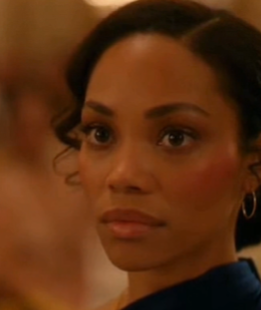
A wealthy woman slapped the “nobody” sitting at the head table and ordered her to leave… She had no idea she’d just humiliated the most powerful woman in the room.
The slap landed before anyone could process what was happening.
It struck Linda Harris on the cheek — not hard enough to bruise, but hard enough to silence an entire wedding hall of two hundred guests. Crystal glasses stopped mid-clink. Laughter died in throats. Somewhere near the back, a child asked why everyone had gone quiet, and no one answered.
Margaret Lawson lowered her hand slowly, as if she’d simply swatted away something unpleasant. She stood at the head table in a champagne gown that cost more than most people’s monthly rent, pearls cinched tight at her throat, chin lifted with the kind of confidence that only comes from decades of never being told no.
She looked at the woman she’d just struck the way a person looks at a muddy shoe on a clean floor.
“Stand up,” Margaret said, her voice low and controlled. “You don’t belong here.”
The woman she’d struck — Linda — didn’t flinch. She sat with her hands folded calmly in her lap, wearing a navy blue dress that was slightly outdated, no jewelry, a thin sweep of lipstick the only concession to the occasion. Against the gold-rimmed plates and cascading floral arrangements of the Whitmore Grand Ballroom, she looked entirely out of place. That had been the point.
At the center of the head table, Emily — the bride, radiant in ivory silk just twenty minutes ago — felt the room tilt beneath her feet.
“That’s my mom,” Emily said. Her voice broke on the last word. “Please… don’t do this. Not today.”
Margaret turned slowly. The disbelief on her face curdled into something uglier.
“Your mom?” She let the word sit there like an accusation. A short, sharp laugh escaped her. “Emily, I asked about your background before this wedding. I did my due diligence. I know where you came from.”
She gestured toward Linda with two fingers, as though pointing required minimal effort.
“A woman from some rural background. No formal education. No standing in any circle I’m aware of.” Margaret’s voice rose just enough — calculated, precise — for the nearest tables to catch every word. “And you placed her at the head table? Between my sister and the family attorney?”
Whispers bled outward through the room like ink in water.
Daniel — the groom, Margaret’s son — had gone rigid beside his new wife. “Mom.” His voice was quiet. Dangerous. “Stop.”
Margaret didn’t look at him.
“I spent seven months on this wedding,” she continued. “This venue was booked fourteen months in advance. Every name on that guest list was considered. Every seating arrangement deliberate.” She paused. “And you bring her — and seat her like she belongs among us?”
She leaned toward Linda then, close enough that her perfume filled the space between them.
“I suggest you gather your things,” Margaret said. “Quietly.”
Linda looked up at her. Her eyes were calm. Not wounded. Not afraid. Observant.
“In a moment,” Linda said pleasantly.
Margaret blinked. That wasn’t the response she’d prepared for.
It was Emily who broke first — not from weakness, but from the particular grief of watching two worlds collide and being powerless to stop it. Tears cut silently down her cheeks.
“Mom,” she said, turning to Linda. “Why didn’t you tell me? I would have introduced you properly. I would have—”
“I know,” Linda said gently. She reached over and pressed her palm against Emily’s hand. “That’s exactly why I didn’t.”
She let that settle.
Then Linda reached down to the bag resting beside her chair — a plain leather tote, unremarkable — and removed a small stack of documents. She set them on the table without fanfare.
The wedding coordinator, hovering nervously at the edge of the room, took a single step forward and stopped. His face had gone the color of old paper.
Because he recognized the letterhead.
Harris Hospitality Group. Forty-three properties across eleven states. A name that appeared in Forbes profiles and ribbon-cutting ceremonies and charitable foundations bearing its founder’s signature.
Linda Harris. Founder and majority stakeholder.
The coordinator’s voice came out barely above a whisper. “Ms. Harris… I had no idea you were—”
“You’re not at fault,” Linda said simply. “You treated me exactly as I presented myself.”
She looked at Margaret.
“That was the experiment,” Linda said. “Emily told me your family valued tradition, reputation, legacy. I wanted to see what that meant in practice. Whether it meant integrity — or simply the performance of it.”
Margaret’s hands, still raised slightly from where she’d gestured, began to tremble.
“This is a setup,” she said. The word came out hollow. “You engineered this.”
“I observed,” Linda replied. “There’s a difference.”
The table had gone completely silent. Even the guests at the nearest tables had abandoned all pretense of private conversation.
“At a wedding,” Linda continued, “we celebrate union. Commitment. The decision to build a life beside another person.” She looked slowly around the table — at the guests who had laughed, at those who had looked carefully away, at those who now couldn’t meet her eyes. “Today, I saw how this family defines those values when they believe no one important is watching.”
Daniel stood up. His chair scraped back hard against the floor.
“Mom,” he said, and the single word carried everything — disappointment, resolve, a line being drawn. “Apologize. Right now.”
Margaret stared at her son. “You’re choosing her side?”
“I’m choosing decency,” Daniel said. “You struck my wife’s mother. At our wedding. In front of everyone we know.”
“I didn’t know who she was,” Margaret said. Her voice cracked on the last word.
Linda tilted her head just slightly. “That’s the point, Margaret.”
The silence that followed was the loudest thing in the room.
Linda gathered the documents back into her bag, stood, and smoothed her navy dress with one hand. She was not a tall woman. She didn’t need to be.
“I won’t disrupt this evening further,” she said. “This day belongs to Emily and Daniel.”
She turned to her daughter, whose tears had not stopped but whose chin had lifted.
“I’m proud of you,” Emily whispered, stepping forward into her mother’s arms. “For everything.”
Linda held her tightly for a moment. “Be proud of yourself,” she said. “You chose well. I watched him today too.”
The ceremony resumed after a long, fragile pause. Glasses were lifted. Music resumed. The evening carried forward, as weddings do, with its own momentum.
But Margaret Lawson sat in silence for the rest of the night. The woman who had commanded rooms for forty years now stared at her plate, a study in stillness. No one came to speak to her. No one quite knew what to say.
Three weeks later, news moved quietly through the social circles that Margaret had so carefully cultivated over a lifetime. Linda Harris had transferred a minority equity stake in the Harris Hospitality Group to Emily — not as a wedding gift, not from maternal obligation, but, as the accompanying letter noted, in recognition of character demonstrated over time.
Emily framed the letter. Not for the money. Not for the status.
But for the last line, which read simply:
“You were chosen for who you are. That is the only inheritance that matters.”
Leave a Reply