
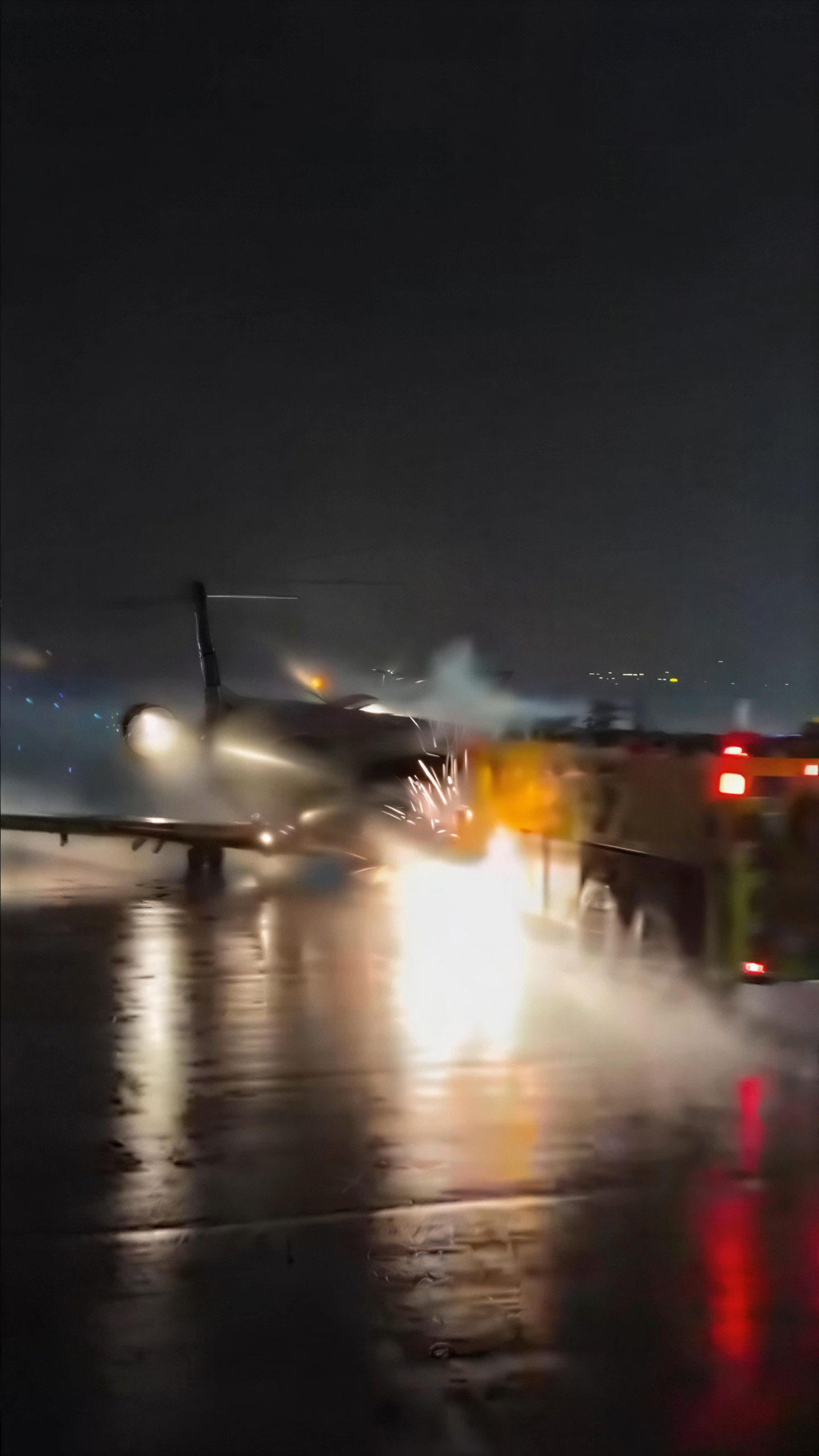
Two pilots had seconds to brake as hard as they could — and took the full impact so 72 passengers could walk away. They never made it home.
It was supposed to be an ordinary Sunday night flight. Air Canada Express Flight 8646 — a Bombardier CRJ-900 operated by Jazz Aviation — departed Montreal’s Trudeau Airport at 10:12 PM, already delayed over two hours. It was bound for LaGuardia Airport in New York, carrying 72 passengers and 4 crew members. Wikipedia Most of them were asleep before the wheels left the ground.
Heavy rain fell across New York City that night. Visibility at LaGuardia had dropped to just 3 miles. Water pooled on the tarmac. Wikipedia The conditions were difficult — but not unusual for a regional approach. Captain Antoine Forest and First Officer Mackenzie Gunther had flown in worse.
At 11:35 PM, the LaGuardia tower cleared Flight 8646 to land on Runway 4. The cockpit voice recorder captured the moment: routine, controlled, professional. ALPA Two minutes and seventeen seconds later, the recording would end.
What neither pilot could have known: at the same time they were on final approach, a United Airlines flight across the airport had reported a strange odor on board. The airport’s rescue and firefighting team responded. A fire truck — Truck 1 — was cleared to cross Runway 4. ALPA
Twenty-five seconds before the collision, Truck 1 requested to cross the runway at Taxiway Delta. Five seconds later, ATC cleared it to cross. NPR The plane was already descending through the mist, locked on approach.
An air traffic controller saw what was happening and screamed into the radio: “Stop. Stop. Stop. Stop, truck 1. Stop.” Nine seconds passed. Then they collided. cbc
Passenger Clément Lelièvre, a French national and frequent flyer, felt it happen in real time. “Just as the plane touched down, the pilot braked extremely hard,” he told the Canadian Press. Jazz Aviation LP Passenger Rebecca Liquori felt the same — the pilots braking with everything they had to slow the aircraft before impact.
The jet struck the Port Authority fire truck at 104 miles per hour. CNN The impact crushed the nose of the aircraft. Cables and debris dangled from the mangled cockpit. The fire truck flipped onto its side. Jazz Aviation LP
Passenger Jack Cabot described the seconds after impact: “We immediately hit something and it was just chaos in there. About five seconds later we had come to a stop… everybody was hunkered down and everybody was screaming pretty quickly. We didn’t have any directions because the pilot’s cabin had been kind of destroyed, so somebody said, ‘Let’s get the emergency exit and get the door and let’s all jump out,’ and that’s exactly what we did.”
One flight attendant was found alive outside the aircraft, still strapped to her seat.
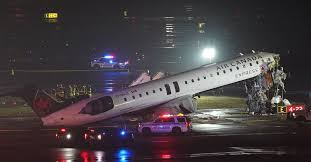
The cockpit and forward galley sections of the aircraft were destroyed. Both pilots were killed. Captain Antoine Forest was 30 years old, from Coteau-du-Lac, Quebec. His great-aunt told the Toronto Star: “He was always taking courses and flying. He never stopped.” CNNFirst Officer Mackenzie Gunther was 24, from Peterborough, Ontario. Seneca Polytechnic flew its campus flag at half-mast in their memory.
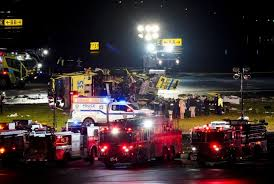
Forty-one people were hospitalized. The two firefighters in the truck were both injured but expected to survive.
Rebecca Liquori, her voice breaking, told reporters: “I’m just so appreciative that they were able to save us, but I’m just so sad that they weren’t able to make it home to their families. I wouldn’t be here had it not been for the pilot acting quickly.”
The NTSB investigation found that the airport’s ground-surface radar system — ASDE-X — failed to issue a collision warning because vehicles merging near the runway prevented it from building a clear track. The fire truck also had no transponder, meaning controllers couldn’t pinpoint its exact location.
NTSB Chair Jennifer Homendy summed it up plainly: “Our aviation system is incredibly safe because there are multiple, multiple layers of defense built in to prevent an accident. So when something goes wrong, that means many, many things went wrong.”
It was the first fatal accident at LaGuardia in 34 years — and it happened on the same calendar date as the last one, USAir Flight 405, in 1992.
The investigation is ongoing. The two pilots’ seats are empty. And 72 people woke up Monday morning because Antoine Forest and Mackenzie Gunther braked as hard as they possibly could in the final seconds of their lives.
Based on confirmed reports from NTSB, CBC, and survivor testimonies. Investigation is ongoing.
Leave a Reply