

At 2:30 a.m., I heard my husband whisper to his mother: “Maybe it’s time she wakes up.” He wasn’t talking about me sleeping…
I never thought a rainy Tuesday night would be the moment my marriage cracked open.
It started the way most catastrophic things do — quietly.
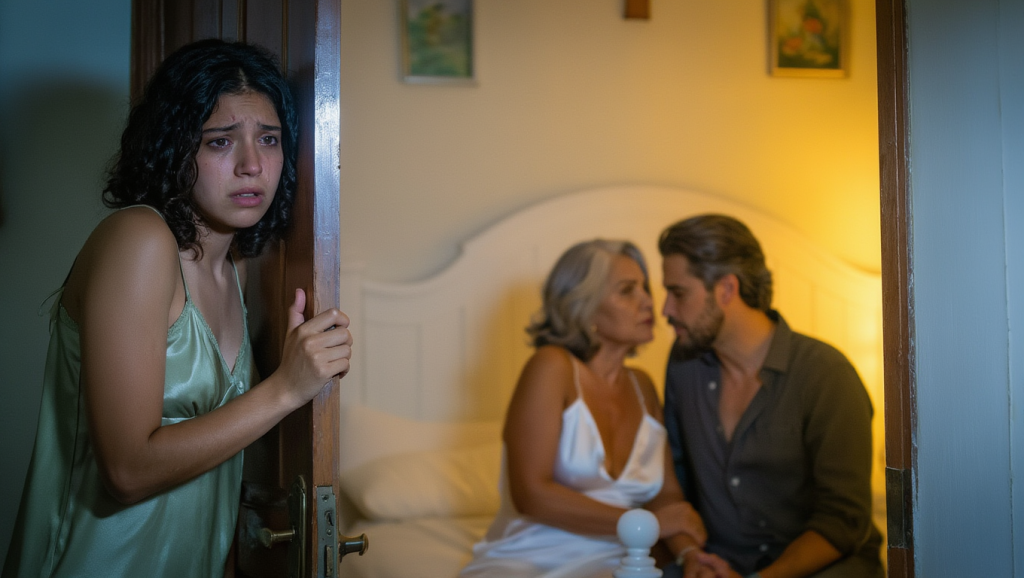
I’d gotten up for water. The house was dark, and the storm outside pressed against the windows like it was trying to get in. As I padded down the hallway in my socks, I noticed the faint strip of light beneath Margaret’s door. And then I heard him.
Ryan’s voice — but not any version of it I recognized.
Low. Strained. Hollowed out.

“I can’t do this anymore, Mom. I don’t know how long I can keep pretending.”
I stopped breathing.
My husband of four years was sitting in his mother’s room at 2:30 in the morning, and something in his voice told me this wasn’t the first time.
Margaret’s reply came low and controlled. “Lower your voice. You’ll wake her.”
There was a pause — the kind that has weight — and then Ryan said the seven words that changed everything.
“Maybe it’s time she wakes up.”
I don’t know what made me look. Maybe it was instinct. Maybe it was the particular quality of silence that follows something that cannot be taken back. But I leaned toward that sliver of open door, and what I saw stopped my heart.
Ryan was hunched at the edge of her bed, face in his hands, shoulders curved inward like a man trying to make himself smaller. Margaret sat beside him, running her fingers slowly through his hair.

Slow. Deliberate. Possessive.
Not the way a mother soothes a grieving child. Something else. Something that had no name I wanted to give it.
“I’m exhausted,” Ryan whispered. “I can’t keep this up.”
“You’re doing what’s right,” she said.
“For you.”
Her hand paused for just a fraction of a second, then resumed its motion. “Don’t start that again.”
“I have a wife,” he said, and his voice cracked on the word. “A real one. I can’t keep pretending she’s just… temporary.”
Temporary.
I pressed my back against the hallway wall. The rain hammered on. My chest felt like something had reached inside and squeezed.
Temporary.
That word settled into me like a stone into still water — slow, undeniable, sinking.
“You made a promise,” Margaret said.
“I was seventeen,” Ryan replied. “You were all I had. But things are different now.”
“No.” Her voice was flat and certain. “You think they are. But they’re not.”
I walked back to bed. I lay beside my husband’s empty space and stared at the ceiling until the rain stopped and the sky turned gray and the birds began again. I did not sleep once.
In the morning, everything looked the same.
Ryan kissed my forehead before work. “You okay?”
“Just tired,” I told him. “Storm kept me up.”
He smiled — but not with his eyes.
Margaret was already in the kitchen, both hands wrapped around her tea the way she always did. She looked up at me and said, “You look pale, dear,” and let her gaze linger just a half-second too long.
She knew I had been in that hallway. Maybe not for certain. But she suspected.
Over the next few days, I began to see what I had been choosing not to see.
Ryan consulted Margaret before making any decision. Not major ones — all of them. What we ate for dinner. Where we spent the holidays. The color of our living room walls. He asked her first, always, with the quiet instinctiveness of someone who has been trained not to trust his own judgment.
Whenever Ryan and I made plans, Margaret would become unwell. A headache. Dizziness. Anxiety that needed attending. And Ryan would attend to it. Every time. Without fail. Without question.
If we talked about moving into our own place, she would find a reason — her health, her loneliness, her need — and Ryan would go quiet the way a door goes quiet when it locks.
What I had once called closeness, I now saw clearly.
It was a leash. And he had grown up believing it was love.
Three nights after the hallway, I couldn’t carry it alone anymore.
“Ryan,” I said, sitting across from him in our own living room, which somehow felt like neutral territory. “We need to talk.”
He stiffened. “About what?”
“I heard you. That night. In her room.”
The color left his face so quickly I almost felt sorry for him.
“You shouldn’t have been listening,” he said.
“I wasn’t trying to,” I replied. “But what I heard — Ryan, what is happening in this marriage?”
He stood up and paced. He does that when he’s cornered — moves his body when he doesn’t know what to do with his thoughts.
“You wouldn’t understand,” he said.
“Then help me understand. Because right now I feel like I’m living with someone I’ve never met.”
He stopped pacing.
He took a breath so long and slow that it sounded like something he’d been holding for years.
“My mother doesn’t believe in sharing,” he said.
“What does that mean?”
“When my dad left, she fell apart completely. I was twelve. I was all she had. And she made absolutely sure I knew that.” He gave a hollow, mirthless laugh. “She’d get sick whenever I spent time away. Panic attacks. Fainting spells. Doctors ran every test they had and found nothing. But it always worked. I always came back.”
“And when you met me?”
“She hated it.”
“Then why did you marry me?” My voice came out smaller than I intended.
He looked at me with eyes full of something fractured. “Because I love you.”
“Then why,” I asked, “does it feel like I’m always competing with her?”
He didn’t hesitate.
“Because you are.”
He told me everything that night.
The promise Margaret extracted from him when he was seventeen — that no woman would ever replace her. That she would always come first. He had agreed because he was a teenager who had never been shown that love could exist without conditions, without debt, without scorekeeping.
“I didn’t know how to say no,” he said.
“And now?”
He looked at me across the coffee table like I was an ocean he didn’t know how to cross. “Now I don’t know how to break it.”
I let the silence sit between us for a moment.
“I can’t live like this,” I said finally. “I won’t be second in my own marriage. Every time she calls, you leave. Every time she needs you, I disappear. That’s not a partnership. That’s a performance.”
He didn’t argue.
Because he knew I was right.
And that, somehow, made it worse.
The next morning, I packed quietly.
No screaming. No slamming drawers. Just me, folding my things into a suitcase with the careful, deliberate movements of someone trying to hold themselves together.
Ryan stood in the doorway.
“You’re leaving.”
“Yes.”
“For how long?”
“I don’t know,” I said. “Until you decide what you actually want your life to look like.”
“I want you,” he said quickly.
“Then choose me.”
“And my mom—”
“You are not a child,” I said, and I kept my voice steady even though my hands were not. “You don’t have to choose guilt over love. You don’t have to keep paying a debt you never should have owed.”
He stood there.
He didn’t move.
And that told me everything I needed to know.
As I rolled my suitcase past Margaret’s room, her door opened.
She stood in the frame, perfectly composed, like she had been waiting.
“You’re leaving,” she said.
“Yes.”
She nodded slowly. “Some women aren’t strong enough to understand certain bonds.”
I met her eyes.
“No,” I said quietly. “Some bonds aren’t meant to exist.”
Something moved across her face — not anger. Something older and quieter than anger.
Fear.
I walked out the front door and into a cold gray morning, carrying a suitcase and a broken heart and something I hadn’t expected to find in all of this.
Clarity.
The months that followed were not easy. There were nights when missing him felt physical — like pressure behind the sternum, like breathing through cloth. I second-guessed myself constantly in the beginning. Wondered if I had asked too much. Expected too much. Loved improperly.
But slowly, gradually, the quiet in my own apartment began to feel like peace instead of punishment. I slept through the night. I made decisions without looking over my shoulder. I remembered, cautiously, who I had been before I started disappearing.
Three months after I left, my phone rang.
Ryan.
I let it ring twice. Then I answered.
“Hey.”
His voice was different. Steadier. Like something had been set down.
“I moved out,” he said.
My heart skipped. “What?”
“I got my own place. I told her I can’t live that way anymore.” A pause. “It was the hardest thing I’ve ever done.”
“I know,” I said softly.
“I should have done it sooner. For you. For us.”
I didn’t say anything for a moment.
“I’m not asking you to come back,” he added quickly. “I just needed you to know.”
“Thank you,” I whispered. And I meant it.
We didn’t rush back to each other. Because love, on its own, was never the problem. Love without boundaries, love without selfhood, love without the courage to disappoint someone who uses your guilt as currency — that was the problem.
Six months later, we met for coffee.
No agenda. No promises. No one watching from the other room.
We talked for three hours.
And for the first time since the night I stood in that hallway and heard the word temporary —
There was no one standing between us.
Just two people, at a small table, figuring out if the thing they had built was worth rebuilding.
Slowly. Honestly. This time, on their own terms.
Leave a Reply