
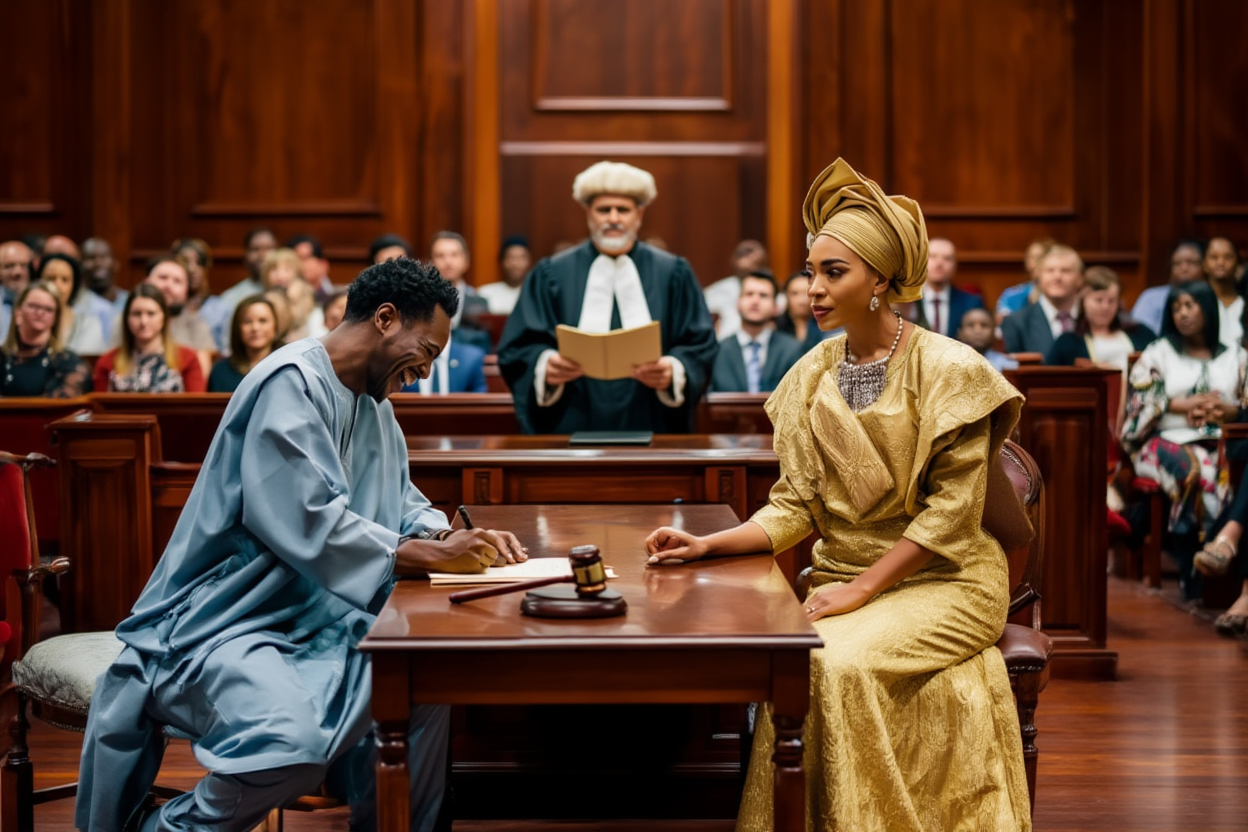
He laughed out loud signing the divorce papers, whispering to his lawyer that she had nothing. Then the judge read out her bank balance — and the whole courtroom went silent.
When Abani Thompson was 22, she fell in love with a dream before she fell in love with the man.
Musa Kane had no money, no product, and no proof — just a fire in his eyes and a voice that made you believe the impossible was already halfway done. She was counting other people’s money at a bank teller window, saving every coin for her own college tuition, when she met him on a rainy Tuesday. He was dripping wet and pitching his idea to anyone who would stand still long enough to listen.
“It’s going to change everything,” he told her, sketching a logo on a damp napkin. A fashion-tech app. Designers meeting buyers. Culture meeting capital.
She believed him. God help her, she believed him completely.
Abani left her safe job. She typed code at night while Musa pitched during the day. She sold her grandmother’s gold bracelets — the last gift her mother had pressed into her palms before cancer took her — and handed the money to Musa without flinching. “For us,” she said, kissing him softly. “We’ll make it big together.”
For four years, they lived on ramen and ambition in a one-bedroom apartment where the radiator clanged all winter. She worked odd jobs to cover rent and spent weekends sewing fabric samples for his brand. He would pull her close on their lumpy couch and whisper, “You’re my rock.” She believed that too.
Then the app launched. Downloads exploded. Investors called. And almost overnight, Musa Kane became someone new — someone whose name appeared on magazine covers, whose face lit up LED billboards, whose laugh bounced off the walls of rooftop parties Abani attended like a ghost.
She was still there, still smiling, still resting her hand on his arm in photographs. But the spark in his eyes, the one that had once been lit by her presence — it had moved. It lived now in the flash of cameras, the clink of champagne glasses, and the attention of women who had never eaten ramen in their lives.
The cracks started quietly.
At a product launch, Musa introduced her to investors as “Abani — she keeps things running,” his arm already draped around a model in a slit dress. Not partner. Not love. Not the woman who wrote half his pitch deck at 2 a.m. Just a function. A support system. A convenience.
At dinner, he started calling her “A-Baney” — a little joke, he said, a play on her name. “My little helper.” He’d grin. She’d smile back, and then cry in the bathroom afterward, pressing her palms against the cold sink and whispering to her own reflection: I am more than this. I am more than this.
But the night it truly ended, she came home after a double shift to find him sitting on the couch, phone in hand, wearing the expression of a man who had already made a decision.
“We need to talk,” he said flatly.
“What’s wrong?”
He sighed — the particular sigh of someone who finds another person’s pain inconvenient. “This life is big now. I need someone who fits it. Abani, you’re amazing, but I need… more.”
The word landed like a slap.
More. After the bracelets. After the sleepless nights. After the four years of ramen and napkin logos and whispering “for us” into the dark.
“You used me like a stepping stone,” she said, her voice fracturing.
He stood up, already moving toward the door. “Don’t make it ugly.”
The door slammed. Rain hammered the windows. And Abani Thompson sat alone on the floor of an apartment she had kept alive with her own two hands, and cried until there was nothing left.
But morning brought something unexpected.
Not sadness. Not bitterness.
Fire.
She pulled out a sketchbook she’d kept hidden for years — pages filled with her own designs. Bold prints. Flowing silhouettes. Clothes built for real women, for every skin tone, for every body that had ever been told it didn’t fit the frame.
“My vision,” she whispered, tracing the lines with her fingertip.
For the next 18 months, Abani lived a double life. By day, she faded gracefully into the background of Musa’s world, raising no flags, drawing no attention. By night, she became someone else entirely. She coded her own website from a library computer. She sewed samples in secret. She emailed buyers under the name ABN Studio, her initials reborn as a brand.
Bold. Beautiful. For every woman.
The orders came in slowly, then all at once. Fifty thousand dollars her first month. Then a hundred. Then investors calling, not because of whose arm she was on, but because of what she had built with her own hands, in secret, while the world watched someone else.

Then Musa filed for divorce.
Irreconcilable differences, the papers read. She doesn’t fit anymore.
He signed them smiling. His lawyer had already told him it would be clean — she had no property in her name, no visible assets, no claim to the empire they had built “together.” He leaned back in his chair and laughed, quiet and satisfied, the way a man laughs when he believes the game is already over.
He had not done his research.
In the courtroom, his lawyer laid it out smoothly. “Mrs. Kane has no independent holdings, no property, no financial claim of significance.”
The judge — a composed woman with reading glasses and the patience of someone who had heard every version of this story — looked up from her papers.
“Mrs. Thompson,” she said. “Your response?”
Abani stood. Shoulders back. Chin up. Eighteen months of yoga and willpower and 4 a.m. work sessions running through her bones like steel.
She opened her folder and placed it on the table.
ABN Studio. Valued at $18 million. Distribution deals with Vogue. A seed investment round. An LLC established — with timestamps, emails, and documentation going back to a single library computer login from a rainy Tuesday eighteen months ago.
The courtroom exhaled all at once.
Musa’s face went the color of old paper.
“That’s — that’s not possible,” he stammered. “She hid this. That’s fraud —”
“The fraud in this marriage,” the judge said, removing her glasses slowly, “was not Ms. Thompson’s.” She reviewed the documentation. Every timestamp. Every email. Every proof of independent creation, built on her own time, with her own capital, under her own name. “Mr. Kane, your wife did not deceive you. She simply — finally — worked for herself.”
The gavel came down.
All assets returned to Abani Thompson. No alimony requested. None needed.
Musa stood up, jaw tight, the crown he’d been wearing for three years suddenly sitting crooked. “You used me,” he said, low and furious. “Used our marriage to build this.”
Abani looked at him for a long moment — at the man she had once kissed in the rain, the man she had sold her grandmother’s bracelets for, the man who had called her a phase.
“I used sleepless nights,” she said quietly. “I used grief and code and fabric scraps. I used every single thing you overlooked about me.” She picked up her folder. “You used me first. I just made sure something remained.”
She walked out of that courtroom and didn’t look back.
The internet erupted, of course. His podcast fans flooded her comments: gold digger, traitor, clout chaser. A distant aunt called to warn her she was burning her meal ticket. Even old friends hedged, unsure whose side held more social currency.
Abani turned her phone face down and went back to work.
ABN Studio launched publicly with a pop-up in SoHo — a space filled with prints in every color, models in every shade, a room that felt, for the first time, like it had been built for women who had always been told they were too much of one thing and not enough of another.
“For the unseen,” she told the crowd, her voice carrying clean and sure across the room.
Five million dollars in seed funding followed. Then a Vogue feature: ABN: Bold, Black, Unbreakable. Then a TED Talk that racked up eleven million views in a week — a woman standing on a stage, no notes, just truth.
“Love shouldn’t dim your light,” she said, her voice steady. “It should be brave enough to let you shine.”
Musa called once, late at night, his voice small in a way she’d never heard before. “I miss you. We could fix this.”
Abani stood at the window of her loft, sketches pinned to every wall, city lights spread out below her like something she had earned.
“You thought of me as a step,” she said. “Not a star.” A pause. “Goodbye, Musa.”
She hung up. Looked at her reflection in the dark glass.
Smiled.
ABN crossed twenty million dollars. The girl who had sold her grandmother’s bracelets for someone else’s dream had built an empire out of her own.
Not for revenge. Never for revenge.
For herself. For every woman who had ever whispered into a cold bathroom mirror: I am more than this.
She was.
Leave a Reply