
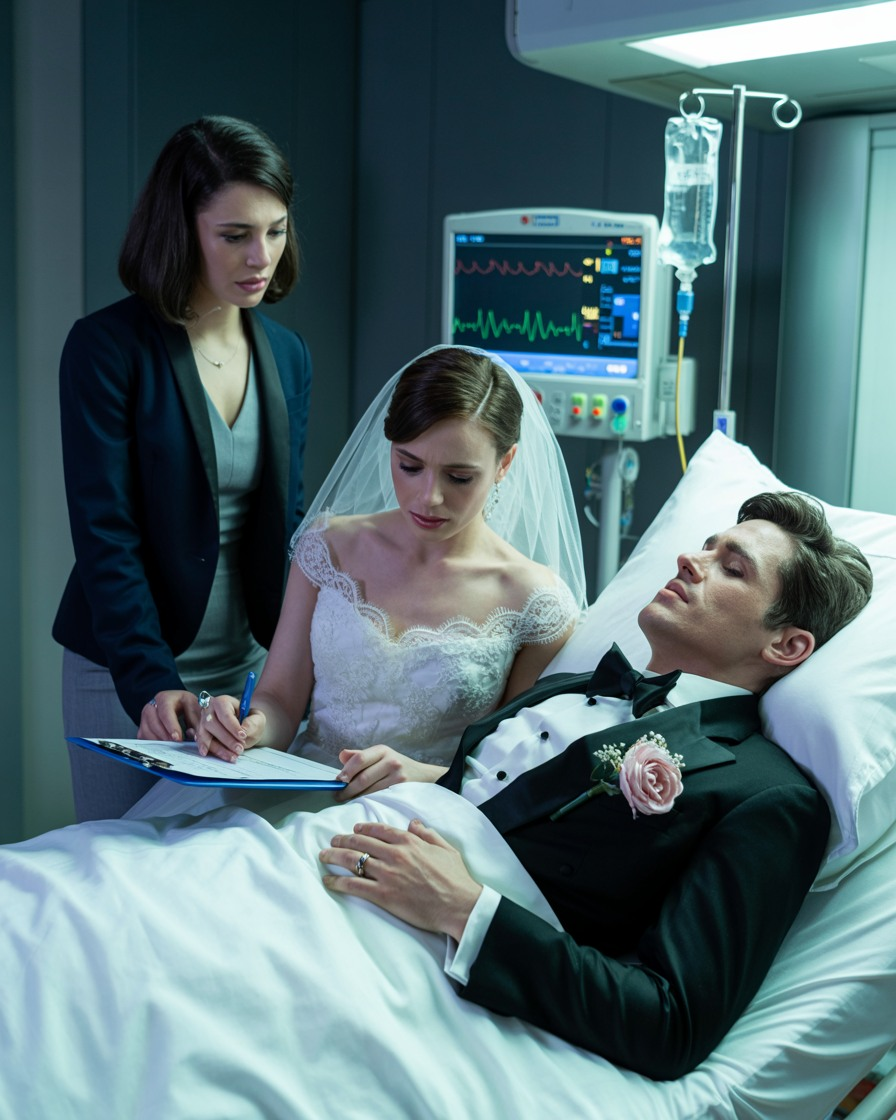
Her family forced her to marry a millionaire she’d never met — a man lying in a coma. She said yes to save her dying mother. Then he woke up.
The pen scratched across the sketchbook page at 2:47 a.m., tracing a face Clara James had memorized without ever truly knowing — sharp jaw, still brow, lashes resting like a man simply asleep. Not dying. Not gone. Just… waiting.
She told herself that every night.
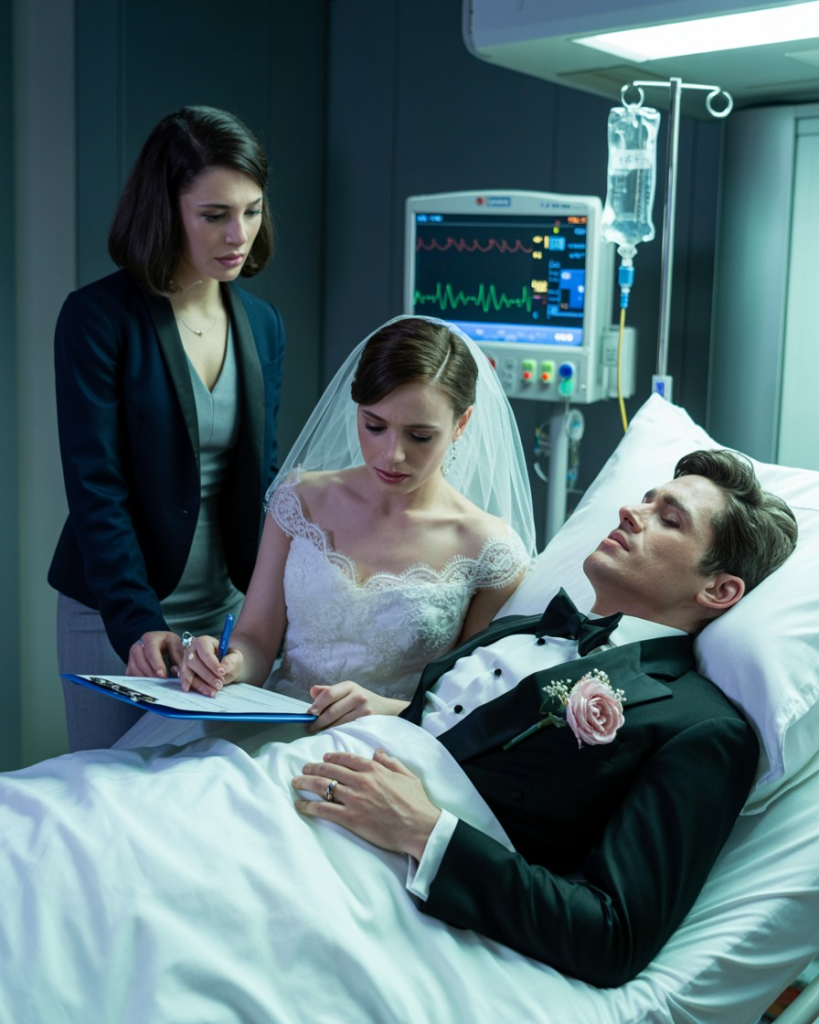
The Dallas hospital hummed its mechanical lullaby around her — the drip of an IV, the soft alarm from down the hall, the squeak of a nurse’s shoe on linoleum. Clara sat in the corner chair of Room 14-B, sketchbook balanced on her knees, pretending she wasn’t terrified.
Pretending she wasn’t Mrs. Ethan Cole.
Three weeks ago, she had been Clara James — twenty-three years old, drowning in $47,000 of her mother’s medical debt, working double shifts at a print shop and selling charcoal portraits outside the farmers’ market on weekends. She had been surviving. Barely. But surviving.
Then Aunt Margaret had called.
“Your sister ran,” Margaret had said, her voice flat as a verdict. “The wedding is in four days. The Cole family needs a bride. You need money for Lydia’s treatment.”
Just like that. As simple and as brutal as that.
Her sister Diane had always been the beautiful one, the chosen one — hand-picked by the Cole family’s matchmakers like a rare orchid. But Diane had packed a bag in the night and vanished, leaving behind only a note that said I can’t. Clara had understood. She had envied her.
But Lydia — their mother — was running out of time.
The civil ceremony lasted eleven minutes. Clara wore a cream blouse she’d ironed three times. There were no flowers, no vows that meant anything, no guests except two Cole family lawyers and Aunt Margaret, whose expression never softened into anything resembling pride. The man Clara married lay upstairs in a medically induced coma, brain swelling slowly receding from a car accident two months prior. His signature on the marriage certificate had been given by medical proxy — a detail so cold it had made Clara’s hands shake as she signed her own name.
Mrs. Ethan Cole.
The ink felt like a cage door closing.
She told herself it was temporary. She told herself she was doing it for her mother, and that was true — gloriously, painfully true. The Cole family’s legal team had guaranteed Lydia’s treatment costs in exchange for the marriage maintaining the estate’s inheritance conditions. Clara didn’t fully understand the legality of it. She just understood that her mother would live.
That had to be enough.
Andrew Fletcher, the estate’s senior attorney, had greeted her the morning after the ceremony with barely concealed contempt. “Mrs. Cole,” he’d said, letting the name sit in the air like a joke he was waiting for her to acknowledge. Clara had looked him directly in the eye and said nothing. She was learning that silence was its own kind of armor.
She visited Ethan every evening after her shift. She didn’t know why, at first. Guilt, maybe. Curiosity. But somewhere in the second week, she realized it was because his room was the only place she didn’t have to explain herself.
She sketched him. His profile. The way the light fell across his shoulder at dusk. The particular stillness of a person the world was holding its breath for. She filled twelve pages without meaning to.
She never showed anyone.
The Cole family dinners were the hardest. Ethan’s relatives welcomed her with the specific warmth of people performing generosity — complimenting her composure, her “dignity,” while their eyes moved over her with quiet, measuring judgment. She was a Black woman who had appeared suddenly at the edge of their gilded world, and they wanted her to feel the weight of that every moment she sat at their table.
She did. She sat up straighter.
Lydia was improving. Slowly. The new treatment protocol was working. One afternoon, Clara sat beside her mother’s hospital bed — a different floor, different wing — and held her thin hand while Lydia slept. She watched her mother breathe and let herself feel, for just a moment, the fullness of what she had traded.
It was worth it, she thought. It has to be.
Then, on a Tuesday morning in March, Ethan Cole opened his eyes.
The news moved through the hospital like electricity. Clara heard it from a nurse in the elevator — “Room 14-B, he’s responsive, he asked for water” — and stood very still while the world reorganized itself around her.
He was awake. The stranger she had married was awake.
She didn’t go to see him that day. Or the next. She wasn’t sure what the protocol was for this — for walking into a room and introducing yourself to your own husband.
Margaret went instead. And when Margaret came back, her face was tight with something that looked like recalculation.
Clara found out later what had been said. A nurse told her, quietly, because nurses always know everything.
Margaret had told Ethan the marriage was a formality. A necessary arrangement. That Clara was “a temporary solution” and that once he was recovered, it could all be quietly undone.
Ethan had listened. And then he had asked to see his wife.
She walked into his room on a Thursday evening, sketchbook tucked under her arm out of habit. He was sitting up, thinner than she’d imagined, a blanket over his lap, a untouched glass of juice on the tray beside him. He looked at her the way people look at someone they’ve been told about but not prepared for.
“Clara,” he said. Not Mrs. Cole. Her name.
“Ethan,” she replied.
Neither of them said anything for a long moment. Outside, Dallas was doing what Dallas does in March — threatening rain, not delivering.
“I’m told,” he said carefully, “that you’ve been visiting. Every evening.”
“I have.”
“Why?”
She considered lying. It would have been easier. Out of obligation. Out of appearances. But she was so tired of performing things she didn’t feel.
“I didn’t want you to be alone,” she said. “You were in a room full of machines and I thought — someone should be here who isn’t getting paid to be here.”
He looked at her for a long moment.
“I’m also told,” he said, “that my aunt is planning to have the marriage annulled.”
“I know.”
“Do you want that?”
The question caught her off guard. She had expected a lot of things from this conversation — accusations, coldness, gratitude delivered from a careful distance. Not that. Not the question turned back on her.
“What I wanted,” Clara said slowly, “was my mother to live. That part is happening.” She glanced at the sketchbook. “The rest I haven’t figured out.”
Ethan nodded, like that was the most honest thing anyone had said to him in months. Maybe it was.
Margaret’s confrontation came the following week. She arrived at Clara’s apartment unannounced, filled the small doorway with her presence, and delivered her accusations with the precision of someone who had rehearsed them.
Clara had lied. Clara had manipulated a vulnerable man. Clara had trapped herself into a fortune that wasn’t hers to claim.
Clara let her finish.
Then she said, quietly: “I signed a contract to save my mother’s life. I visited a man in a coma because he was alone. I drew pictures in a sketchbook and told no one. If that’s manipulation, I don’t know what honesty looks like to you.”
Margaret left. She didn’t apologize. But she didn’t come back.
Three weeks later, Ethan stood in the Cole Enterprises boardroom — still moving carefully, still regaining his strength — and looked at Clara across the long mahogany table.
“You’re the reason I’m here,” he said. “And I don’t mean the contract.”
She didn’t understand at first.
He told her: that in the weeks before he’d opened his eyes, he’d heard things. A voice, reading aloud from what he later realized was her sketchbook descriptions — she hadn’t known he could hear, had sometimes narrated her drawings quietly, the way artists do when they’re alone. Strong jaw. Tired eyes. He looks like someone who has a lot to carry.
He had held onto that voice.
When reporters gathered at the hospital entrance, demanding a statement about the “mystery bride,” Ethan walked out to meet them with Clara at his side.
“She’s my wife,” he said. “And she’s not a story for you.”
The morning he proposed — really proposed, in the garden of the estate as spring came in over the hedges — he knelt in the damp grass with a velvet box and looked up at her like she was the only solid thing in an uncertain world.
“Not out of contract,” he said. “Not out of obligation. Choose me because you want to.”
Clara laughed, which surprised them both. Then she cried, which surprised no one.
“Yes,” she said. “Okay. Yes.”
The headlines shifted over the weeks that followed. Fake Bride became Love Against All Odds became something quieter and truer — a story people shared not for the spectacle but for the feeling it left behind.
Lydia recovered. She came home in May, thinner but bright-eyed, holding the locket Clara had worn through all of it. “My hero,” she said, and Clara shook her head, but didn’t argue.
Clara’s sketches — the ones from the hospital nights, the ones of Ethan sleeping, of Lydia’s hands, of the storm-lit Dallas skyline — were shown at a small gallery in their neighborhood. People stood in front of them and got quiet in the way you get quiet when something is real.
At a community event that summer, Ethan took the microphone and said only: “To Clara — my strength.”
The applause went on for a long time.
They married again in September, in the estate garden under string lights and an honest sky. Clara’s dress was simple — she’d chosen it herself. There were flowers she actually liked. Lydia sat in the front row and didn’t stop smiling.
The vows were their own words. No lawyers. No proxies. No chains dressed up as ceremony.
I choose you, Clara said. Because choosing you is the first thing I’ve done just for myself.
Ethan held her hands and said, Then I’m the luckiest man who ever woke up.
The storm, the contract, the cold signatures — they didn’t disappear. They became the foundation of something stronger than any of it. Clara had walked into that marriage desperate and alone.
She walked out of it loved.
And somewhere, in a sketchbook with tear-stained pages, a stranger’s face looked back at her — no longer a stranger at all.
Leave a Reply