

A poor girl walked into a millionaire’s party and asked to play his piano. He let her. What happened next silenced an entire ballroom — and eventually brought down one of the most powerful families in the country.
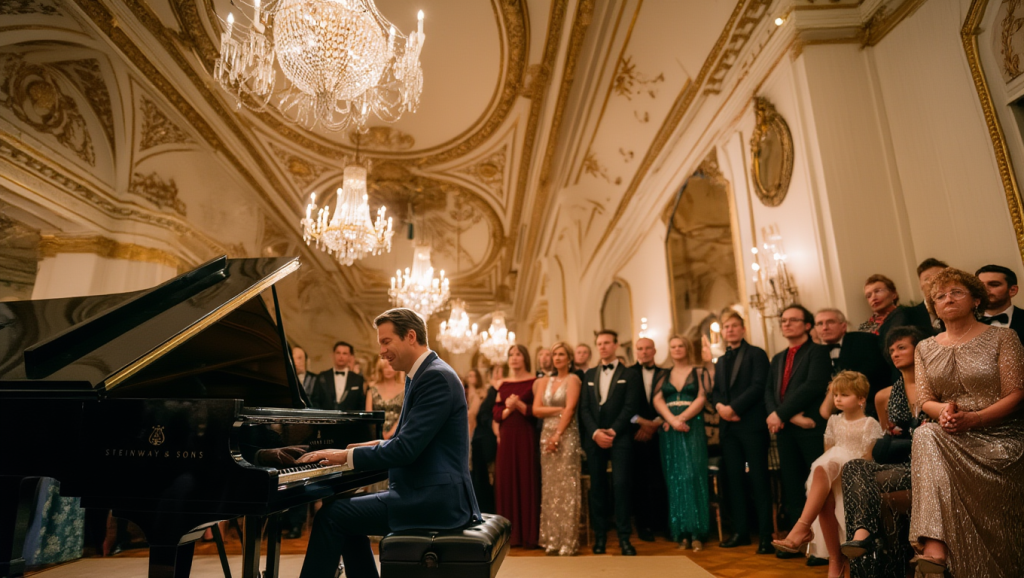
The ballroom of the Palacio Estrella was not a place for ordinary people. Crystal chandeliers dripped light onto marble floors, imported wine filled crystal glasses, and at the center of it all sat a black Steinway grand piano — polished, untouched, waiting for the heir.
Julián Ignacio Luján Rivas played flawlessly that night. Every note was exact, every phrase controlled. The audience applauded on cue. But the music felt like a painting behind glass — beautiful, distant, and completely safe.
Then a side door opened.
A small girl slipped into the hall. Her dress was simple. Her shoes were worn. She walked straight to the stage and, in a voice too calm for her size, asked if she could play.
The laughter came fast. Julián’s mother, Isabel, was already signaling security. But Julián raised his hand and stopped them. He placed a cushion on the bench. He helped her sit. No one in the room understood why.
Her mother, Clara, burst through the door a moment later — too late.
The girl touched the keys.
What came out was not trained or polished. But it was alive. The melody moved through the room like something that had been waiting years to be heard — full of grief, memory, and a longing that no amount of wealth could manufacture. Phones dropped. Conversations stopped. Even the guests who had come only to be photographed stood still, listening to something they couldn’t name.
Clara wept openly. Julián felt something inside him loosen for the first time in years.
When the final note faded, the silence held. And then the applause came — not the polite, obligatory kind, but something uncontrolled, almost desperate.
Isabel ended it. Her voice cut through the room, cold and precise. The girl was escorted out. Order was restored.
But Julián followed them into the lobby. He handed the girl — Amelia — a piece of music he had abandoned years ago, and asked her to finish it. Not as charity. As recognition.
A recording of her performance spread within days. Isabel worked to erase it. Julián worked to protect it. Quietly, he created a space where Amelia could play without being watched or judged.
But power rarely stays quiet. Bureaucratic pressure followed — missing documents, questioned legitimacy, closed doors. The system didn’t attack Amelia with cruelty. It simply tried to make her disappear through paperwork.
She didn’t disappear.
Julián and Clara organized a concert in a forgotten theater, open to anyone. Amelia played again. This time, the audience was impossible to dismiss.
Still, recognition without truth leaves power untouched.
At a final gala — the kind where influence gathers under chandeliers and calls itself culture — Amelia walked to the piano and spoke first. She didn’t claim a name or a bloodline. She played a lullaby. Simple. Haunting.
A journalist stood up, visibly shaken. He recognized the melody — it had been sung in an orphanage where children had vanished under circumstances no one had ever fully explained.
Clara confirmed it publicly: Amelia had been left at her door as an infant. What had been a private act of love became the thread that unraveled everything.
The investigation that followed exposed a network of corruption tied directly to the Luján family. The structures they had built — financial, social, legal — began to fracture. Not through force. Through a truth that had finally been given a voice.
In the years after, Amelia didn’t become a symbol. She became a person — surrounded by the people who had chosen her. Julián left his inheritance behind and spent his resources opening doors for others who had been overlooked. Clara remained what she had always been: the foundation.
When someone asked Amelia how a child with a borrowed cushion had brought down something so powerful, she didn’t talk about bravery.
She said: I just played what was true. And the right people refused to look away.
Leave a Reply