
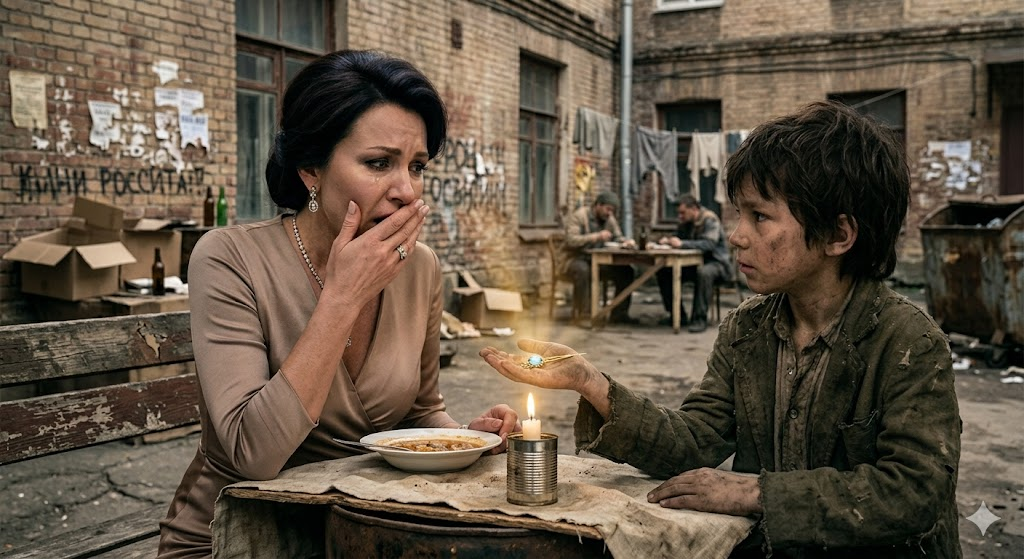
A dirty street boy touched a wealthy woman’s hair in a fancy restaurant — she screamed at him. Then he pulled something from his torn pocket that made her collapse to her knees.
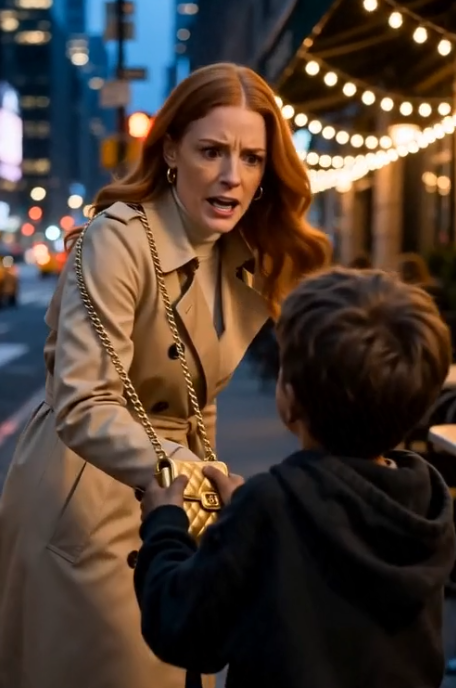
The evening air was golden and warm, the kind that wraps around an outdoor restaurant like a promise. Glasses clinked softly, conversations floated, and the smell of grilled food and fresh coffee made the world feel easy — at least for those lucky enough to be sitting in it.
Lena had built herself into someone who belonged here. Polished. Composed. Her silk blouse, her manicured nails, her long dark hair falling in perfect waves — everything said: I have my life under control.
She was scrolling through her phone when she felt it.
A small hand. Rough. Hesitant. Touching her hair.
“Hey — don’t touch me!” she snapped, loud enough to silence the table next to her.
She turned and found him.
A boy. Eight, maybe nine. Shirtless, barefoot, skin dusted with dirt, hair knotted from weeks without care. He was thin in the way that meant hunger, not childhood. But his eyes — dark, steady, ancient for his age — didn’t flinch.
He didn’t run. He didn’t apologize.
He just looked at her like he’d been searching for her for a very long time.
“She has the same hair…” he said quietly.
Lena frowned, caught somewhere between irritation and unease. “What are you talking about? Who are you?”
The boy’s small fingers clenched at his sides. He swallowed once, hard.
“My mom said I’d find you here.”
The words made no sense. And yet something about the certainty in his voice — the absence of doubt — made her sit up straighter.
“Find me?” she repeated.
He nodded. Then, slowly, he reached into the torn pocket of his shorts.
At first she thought there was nothing there.
Then he opened his palm.
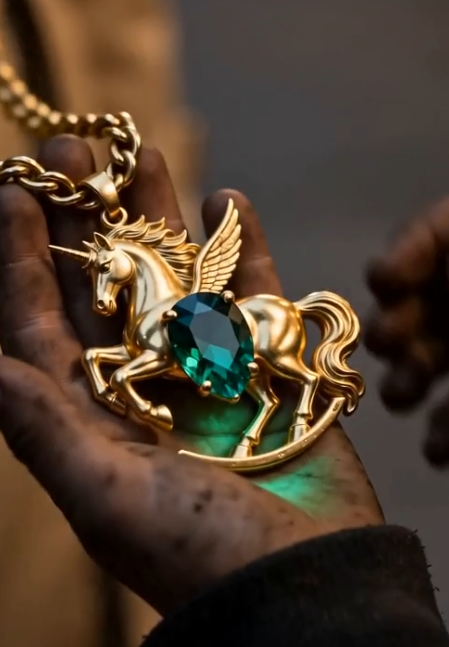
A hairpin. Small, gold-tipped, with a delicate blue stone at its center. Even under the dim restaurant lights, it caught the glow like it remembered better days.
Lena’s breath stopped.
Her hand moved before her mind did. She took it from him, fingers trembling, and the moment the metal touched her skin, years collapsed.
She knew this hairpin.
Not one like it.
This one.
She had given it away — or rather, it had disappeared — over a decade ago, along with everything else she’d lost that year.
“Where did you get this?” Her voice had gone somewhere small.
“My mom gave it to me,” the boy said. “She said if I ever found a woman with hair like hers, to show it to her. She said you’d know.”
Lena could barely form the words. “What is your mother’s name?”
A pause. Just a breath long. But it felt like standing on the edge of something.
“Anaya.”
The name hit her like a door blown open in a storm.
She stood up so fast her chair scraped the stone floor. Nearby diners startled. She didn’t notice. The restaurant, the lights, the evening — all of it blurred into background noise.
Anaya.
Her younger sister. The one who had vanished fourteen years ago without a letter, a call, a single word. The one the family had searched for until searching became too painful, and silence became easier than hope.
“Where is she?” Lena’s voice cracked. “Where is your mother?”
The boy looked down at the ground. “She’s sick.”
The words landed like stones.
“Take me to her.” She didn’t ask. Couldn’t afford to.
The boy hesitated, studying her face as if measuring whether she could be trusted. Whatever he saw must have satisfied him, because he gave one slow nod.
They left together.
The warm lights of the restaurant faded as they walked deeper into the city — from clean wide boulevards into narrow roads with cracked pavement and dim streetlamps. The boy moved quickly, barefoot and sure-footed, navigating every turn like a map he’d memorized out of necessity. Lena followed, her heels catching on broken ground, until she simply reached down and took them off.
They walked in silence.
After twenty minutes, the boy stopped in front of a low structure — four walls, a corrugated roof, a doorway covered with cloth instead of a door.
“This is where we stay,” he said.
Lena stepped inside.
The air was close and still. A single bulb flickered from the ceiling. On a thin mattress in the corner lay a woman — slight, pale, wrapped in a worn blanket despite the warmth of the night.
But unmistakable.
“Anaya…”
The woman’s eyes opened. Confusion first. Then, like fog lifting — recognition. And with recognition came tears, immediate and silent.
“You came,” Anaya breathed.
Lena crossed the room in three steps and dropped to her knees on the bare floor. She didn’t care about the dirt. She didn’t care about anything except the face in front of her — older now, hollowed by years and illness, but still her sister’s face.
“Why did you leave?” she cried, pressing Anaya’s hand between both of hers. “We looked everywhere. For years.“
Anaya’s smile was small and exhausted. “I didn’t want to ruin your life.”
“What does that mean?”
“I made mistakes, Lena. Serious ones. I thought the kindest thing I could do was disappear.” She paused to catch her breath. “I kept the hairpin because I always hoped… one day… if things got bad enough… you’d believe a stranger who brought it to you.”
Lena looked back at the boy, still standing quietly at the doorway. Watching.
“He’s yours,” she said softly. It wasn’t a question.
Anaya’s eyes moved to her son with a tenderness that needed no words.
“His name is Rohan. He’s never known anything easy. But he’s never once complained.”
The boy stood straight at the sound of his name. Still not quite a child in the way he carried himself. But in the dim light of that room, for just a moment — he looked exactly his age.
Lena opened her arm toward him.
He crossed the room slowly. Then, for the first time in what she suspected was a very long time, he let someone hold him. And the careful, serious expression he wore collapsed entirely.
She held them both that night — one fragile and fading, one small and iron-willed — and she made a silent promise to the hairpin still in her palm.
No more silence. No more lost years.
She arranged doctors the next morning. Treatment within the week. And she brought them both — her sister and her nephew — into her home not with charity, but with the kind of love that doesn’t need to explain itself.
Recovery was slow. Some mornings were harder than others.
But Anaya got better.
And Rohan, slowly, learned how to be nine years old.
Lena kept the hairpin on her vanity, and wore it on days she needed to remember what mattered.
Not the restaurant. Not the polished table. Not the image she had worked so hard to build.
But the moment a small, dirty hand reached out in the golden evening light — and gave her family back.
Leave a Reply