
A starving girl played her dead mother’s song in a luxury restaurant… and a stranger froze like she’d heard a ghost.
But before the truth could break — the lights went out.
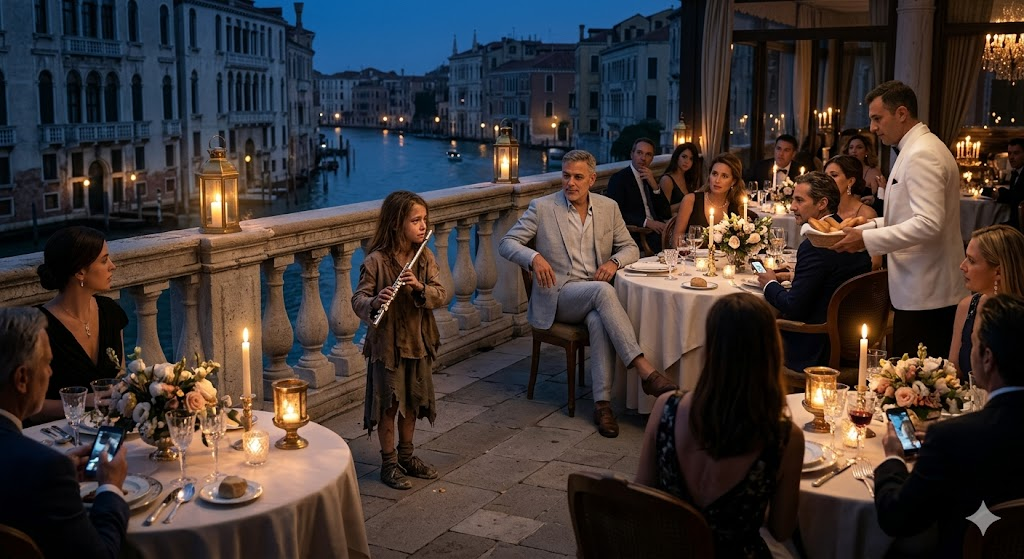
She wasn’t supposed to be there.
The Terrazza Dorata was the kind of place where reservations were made three months in advance and the bread cost more than a meal elsewhere. That evening, the terrace shimmered with candlelight and quiet laughter — the curated calm of people who had never once worried about food.
Then the crying began.
“PLEASE — I JUST NEED MONEY FOR FOOD — PLEASE!!”
The voice was too raw for a place like this. Every head turned. A small girl stood at the edge of the terrace — maybe nine, maybe ten — her clothes the color of exhaustion. She clutched a tiny silver flute to her chest like it was the only thing in the world that was hers.
At the center table, a man in a linen suit leaned back with the slow ease of someone who’d never been told no. He looked her over with the quiet amusement of a man watching a street act he hadn’t asked for.
“If you want money,” he said, loud enough for the table to hear, “impress us.”
A few guests chuckled. Phones rose. The girl’s eyes dropped to the floor. For a moment it seemed like she might simply dissolve — back into the city, back into the dark. But she didn’t.
She lifted the flute.
The first notes were fragile. Almost broken. Like something precious being handled by shaking hands. Then, gradually, the melody opened — not perfect, not polished, but alive in a way that made perfect seem beside the point. It moved through the terrace like something that didn’t belong to any room, any city, any era.
The chuckling stopped. Phones lowered. No one moved.
Across the terrace, a woman in her fifties sat very still. She was elegant in the careful way of someone who had worked hard to become so — silk blouse, pearls, posture that had become habit. But as the melody reached her, something in her face came undone. Her hand went to her mouth. Her eyes filled.
The girl played to the end. Then she lowered the flute and looked up — small, spent, but standing.

“My mom taught me,” she said quietly. “Before she got sick.”
The woman rose from her chair. She crossed the terrace slowly, as if the ground had become uncertain beneath her feet.
“Where did you learn that melody?”
“From her. She played it every night.”
“What is your mother’s name?”
The girl hesitated. Then: “Anna.”
The name hit the woman like a physical thing. The wine glass slipped from her fingers and shattered against the marble. No one reacted. No one breathed.
“Anna Sorel?” the woman whispered. “With a scar — here —” she touched her own wrist.
The girl’s eyes went wide. “How do you know that?”
The woman’s voice broke completely. “Because she’s my daughter. And I’ve been looking for her for eleven years.”
The terrace held its breath. And the girl with the flute stood at the center of a story no one in that gilded room had expected — the kind that doesn’t end with applause, but with two people reaching for each other across an unimaginable distance.
Leave a Reply