
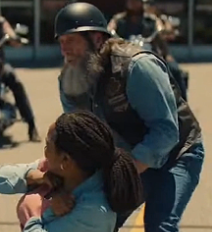
A disabled woman was shoved to the ground at a Texas gas station by an impatient driver… But before her sister could react, the rumble of dozens of motorcycles changed everything.
The heat on Interstate 40 that afternoon was the kind that doesn’t ask permission. It just settles — heavy and patient — over everything, pressing down on car hoods and cracked asphalt alike. My sister Lily and I had been driving since sunrise, windows rolled all the way down because the AC had given up somewhere back in Oklahoma. We called it “natural ventilation.” Lily called it “character building.” That was Lily — always finding a phrase that made something hard sound almost beautiful.
Road trips had become our quiet rebellion. Three years earlier, a car accident changed the architecture of Lily’s life. She woke up from surgery to a world that looked the same but moved differently — one that wasn’t always built for her. A wheelchair became part of who she was. Not all of who she was. Just part.
She never asked for pity. She never waited for permission. And she never — not once — let anyone make her feel like she was less. Most days, she succeeded in that. Most days.
We pulled off I-40 just outside Amarillo, into a roadside gas station that looked like it had been there since the Carter administration. Faded signage. Two working pumps. A hand-painted specials board in the window advertising sweet tea for a dollar. It was exactly the kind of place we loved — unpretentious, honest, real.
The accessible parking spot near the entrance was blocked by a delivery truck, its hazards blinking lazily, no driver in sight. I pulled as close to the pumps as I could manage, helped Lily transfer into her chair, and watched her navigate the cracked, uneven pavement toward the store entrance with the focused patience she’d developed over years of navigating a world that hadn’t been designed with her in mind.
She was maybe twenty feet from the door when it happened.
A red convertible — the kind that announces itself before you see it — swept into the lot fast, top down, music loud. The driver was tan, polished, wearing sunglasses that cost more than my monthly rent. He saw Lily, took in exactly what was in front of him, and honked. Once. Twice. A third time, longer.
“Move it!” he shouted, like she was a traffic cone.
Lily tried. She pushed forward as fast as she could. But the pavement had other plans — one of her front wheels caught hard in a crack, and the chair lurched, throwing off her momentum. I was already moving toward her when the driver threw open his door and came around the front of his car, jaw set, face flushed with the particular fury of someone who has decided his time is worth more than your dignity.
He shoved the wheelchair.
Not hard enough to seem violent, maybe. But hard enough.
Lily went sideways, then down. The chair skidded. Metal hit concrete with a sound that cut through the afternoon heat like something breaking that wasn’t supposed to break. For a half second, the entire gas station went silent — two other customers frozen at the pumps, the cashier visible through the window, all of us suspended in that particular horror of witnessing something you can’t unhappen.
I was between them in three steps. My heart was detonating. I had nothing — no plan, no backup, no idea what I would do if he escalated — but I was there. Standing between my sister on the ground and the man who put her there.
He was already composing his excuse. Something about being in a hurry. Something about not seeing how bad it was. The words were coming out smooth and practiced, the kind of thing someone says when they’re counting on no one pushing back.
And then we all heard it.
Low, at first. A vibration more than a sound — the kind you feel in your sternum before your ears register it. Then it grew, deepened, multiplied. The rumble rolled into the parking lot ahead of them: motorcycles, maybe fifteen, moving in a calm and deliberate formation that filled the lot without chaos, without aggression, without a single raised voice.
They cut their engines in near-unison.
The sudden quiet was its own kind of statement.
A man — big, weathered, with a beard that had been gray for a while and kind eyes that had probably seen everything — walked to Lily first. He didn’t look at the driver. He didn’t grandstand. He crouched down beside my sister, asked if she was hurt, and helped her upright with a steadiness and care that made me want to cry on the spot.
Two others righted her wheelchair. Checked the wheels. Made sure it was intact.
Only after Lily was seated, only after someone had pressed a cold bottle of water into her hand, did the gray-bearded man turn to look at the driver. He didn’t raise his voice. He didn’t threaten. He simply stood there, patient and immovable, and said: “Tell me what happened.”
The driver tried. He tried to soften it, reframe it, scatter the blame across the cracked pavement and the delivery truck and Lily’s own pace. But someone nearby — a teenager at the pumps, phone already in hand — had been recording from the moment the convertible had honked. The footage was clear. Timestamped. Unarguable.
Authorities arrived. The situation moved through its necessary steps without escalating into anything worse. The driver was not permitted to simply drive away.
But what I remember most isn’t the accountability — as real and necessary as it was.
What I remember is Lily’s face when the gray-bearded man asked her to tell him what had happened, and actually waited for her answer. The way she exhaled, just slightly, like she’d been holding something in without knowing it. The way she spoke clearly, calmly — and the way he listened like every word mattered.
Because it did.
We drove away as the sun began its slow descent toward the horizon, painting the highway in amber and copper. Lily was quiet for a long time — the comfortable kind of quiet, not the heavy kind. Then she said it, simply, to no one and both of us:
“I didn’t feel invisible. Not this time.”
I didn’t trust myself to answer. I just reached over and kept my hand on her armrest for the next fifty miles.
Cruelty is loud. It announces itself, demands space, expects no resistance. But compassion — real compassion, the kind that shows up without being called and leaves without asking for credit — that can be louder. Not in decibels. In weight. In what it leaves behind.
That afternoon outside Amarillo didn’t give Lily anything she didn’t already have. It just made sure she knew it was seen. And sometimes, that’s everything.
Leave a Reply