
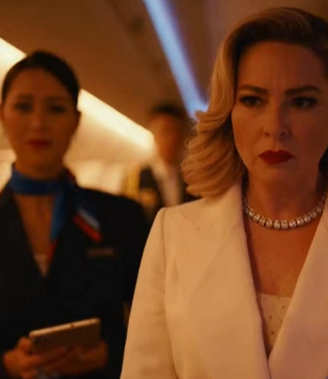
She wore a hoodie. They dragged her out of First Class like a criminal. She didn’t scream. She just checked her watch… and waited for the FAA to shut down the entire airline.
The air inside JFK International Airport was thick with the scent of overpriced coffee and quiet desperation. It was a Friday evening in late October — the kind of night where delays stack like dominoes and patience evaporates before you even reach the security line. For Nia Reynolds, airports were usually a formality. Private terminals, tarmac transfers, a crew that knew her coffee order. Tonight was different.
Her Gulfstream was grounded in Heathrow for an emergency avionics inspection, and Nia had exactly one option: fly commercial. She needed to be in Los Angeles by 6 a.m. for a board meeting that would finalize the single largest logistics acquisition in American aviation history — a deal she had personally spent eleven months engineering.
She moved through JFK in an oversized charcoal cashmere hoodie, worn sneakers, and a battered leather duffel that had seen four continents in the last two weeks. No makeup. Hair in a simple bun. She looked exhausted because she was — 72 hours of negotiations in three countries, four hours of sleep total, and a quiet, electric fury humming just beneath her calm exterior.
At the priority lane for Stratton Airways Flight 404, the gate agent didn’t look up when she approached.
“Boarding pass,” he said flatly.
Nia scanned her phone. The machine beeped green. When the agent finally looked up and registered the 1A on the screen against the woman standing in front of him, something shifted behind his eyes — not recognition, but suspicion.
“Group one is first class only,” he said, his tone carefully constructed to sound helpful while meaning the opposite.
“I know,” Nia said. “I’m in 1A.”
He tapped his keyboard. Checked twice. When the system confirmed what his bias refused to accept, he handed back her passport with a dismissive flick and muttered, “Enjoy your flight,” already looking through her toward the next passenger.
Nia didn’t react. She walked down the jet bridge and turned left.
The first class cabin of the Boeing 777 was Stratton’s crown jewel — gold trim, mahogany veneers, seats that reclined into fully flat beds. Seat 1A was the best on the aircraft: wide, private, positioned directly beside the window at the bulkhead. Nia stowed her duffel, settled in, placed her noise-canceling headphones over her ears, and closed her eyes.
She lasted three minutes.
A sharp tap on her shoulder. Then another.
She pulled the headphones down and blinked into the cabin lights. Standing above her was a woman in a designer coat despite the climate-controlled air — Victoria St. Clair, wife of a hedge fund manager and frequent flyer of considerable self-importance. Her diamonds caught the light. Her expression radiated the particular fury of someone who had never once been told no.
Behind her stood Braden, a flight attendant whose smile was wound so tight it looked painful.
“You’re in my seat,” Victoria announced.
Nia glanced at her phone. “1A?”
“Obviously. I always sit in 1A. My husband plays golf with the CEO. The bulkhead is always held for me.” She turned and snapped her fingers near Braden’s face. “Tell her.”
Braden looked at Nia’s hoodie. He looked at Victoria’s coat. In his mind, the calculation was instantaneous and wrong.
“Ma’am,” he said gently, addressing Nia, “is there any chance there’s been a mix-up with your ticket?”
Nia looked at him for a long moment. “No.”
“Perhaps you’d be more comfortable in—”
“I purchased seat 1A,” Nia said. “On this flight. Tonight.”
Victoria exhaled sharply. “Get the captain.”
Captain Dennis Harlow appeared two minutes later — a broad-shouldered man with silver temples and the confident stride of someone used to being the most important person in any room. He took one look at the situation: Victoria St. Clair, whom his crew flagged as a Platinum Elite member, and Nia Reynolds, whom nobody on that aircraft recognized at all.
“Miss,” he said, his voice calibrated to sound reasonable, “I’m going to have to ask you to come with me. We’ll get this sorted at the gate.”
“My ticket is valid,” Nia said.
“I understand that, and we’ll—”
“Captain.” Her voice didn’t rise. It sharpened. “My boarding pass is confirmed. My seat assignment is confirmed. I am a passenger on this aircraft, and I’m asking you to tell me under what authority you’re removing me.”
“Ma’am, I need you to lower your voice.”
“I haven’t raised it.”
She hadn’t. That was what made everyone in the cabin suddenly very still.
Two gate agents entered the jet bridge. Then a third. Nia stood slowly, smoothed her hoodie, picked up her duffel, and walked off the plane without another word. But before she stepped off, she looked back at Braden.
“Note the time,” she said quietly. “11:47 p.m.”
She sat in a chair at the gate for nineteen minutes.
Then the tarmac outside the terminal erupted.
Three FAA vehicles. Two black SUVs. A Port Authority unit. And a woman in a charcoal hoodie who had made exactly one phone call.
What Captain Harlow didn’t know — what Victoria St. Clair didn’t know, what Braden didn’t know — was that Nia Reynolds was not simply a passenger on Stratton Airways. As of 9 a.m. that morning, following the completion of a $4.3 billion acquisition signed in a London conference room, Nia Reynolds was the majority stakeholder of Stratton Airways’ parent company.
She owned the airline.
The FAA investigation that followed was not about the seat. It was about what Nia’s team had already flagged internally: a pattern of discriminatory removal complaints on Flight 404’s route — six incidents in fourteen months, all passengers of color, all removed from premium cabins under the cover of “ticketing disputes.” Nia had seen the internal reports. She had wanted to understand the culture herself before she restructured it.
Now she didn’t have to wonder.
Captain Harlow was placed on administrative leave pending review before Flight 404 ever left the gate. Victoria St. Clair was escorted from the aircraft by Port Authority — turns out her Platinum Elite status didn’t extend to directing the removal of other passengers. Braden was reassigned pending a conduct investigation.
Flight 404 departed 2 hours and 33 minutes late. Seat 1A was empty.
Nia Reynolds took a charter to Los Angeles and arrived at her board meeting eleven minutes early. She walked in wearing the same hoodie.
When asked by a reporter three weeks later what she thought about the incident, she paused, then said: “I think people show you exactly who they are when they believe there are no consequences. My job was to make sure there were.”
The restructuring of Stratton Airways’ hiring, conduct, and passenger relations protocols was announced the following Monday. It was the most comprehensive overhaul in the airline’s 31-year history.
It began, as most revolutions do, with someone being told they didn’t belong somewhere they absolutely did.
Leave a Reply