
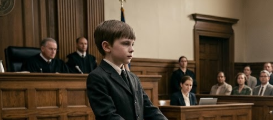
A boy took the stand in a murder trial — and in three seconds, destroyed his uncle’s alibi.
But the maid’s final whispered words revealed the fire was never an accident… it was already too late for his father when the flames began.
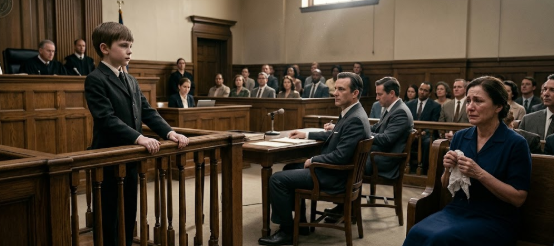
Nobody expected the boy to speak. He was eight years old — slight, pale, still wearing the same dark clothes from his father’s funeral.
The bailiff had offered him a chair, but he stood. Both hands gripped the wooden railing of the witness stand as though the courtroom might tip over without it. Victor Ashworth sat at the defense table in a charcoal suit, expression unmoved. He was the kind of man who made silence feel deliberate — composed under pressure, which was precisely why the jury had yet to find him suspicious.
His lawyer had spent three days building a wall of reasonable doubt. His alibi was airtight. The fire, they said, was a tragedy.
An electrical fault. A frozen winter night, old wiring, and a family destroyed by accident. Then the prosecutor called the boy. “State your name for the court,” she said gently. “Eli Ashworth.” Victor’s jaw tightened — barely.
Only the maid noticed. She sat in the gallery, third row, clutching a handkerchief she had already destroyed by wringing. Her name was Rosa. She had worked for the Ashworth family for eleven years. She had watched Eli learn to walk. She had been the one to pull him, coughing and scorched, from behind the wall. She had not slept since. The prosecutor kept her voice soft. “Eli, do you understand why you’re here today?” He nodded. “To tell what I heard.” “And what did you hear?” Victor’s lawyer was on his feet before Eli could answer — objection, leading, foundation — but the judge waved it down. “Let the boy speak.”
Eli took a breath. “I couldn’t sleep that night. I went downstairs because there was yelling. It was coming from the library.” He paused. “I didn’t go in. I sat on the stairs.” “What did you hear?” “My father’s voice. He was very angry. He kept saying he had the proof. That he had found everything — the accounts, the transfers, all of it.” Eli’s voice was steady in a way no eight-year-old’s should be. “He said whoever was stealing from the company had been doing it for years. That they’d hidden it well, but not well enough.”
The courtroom was quiet enough to hear the heating system tick. “And then?” the prosecutor asked. “He said a name.” Victor went very still. “He said — Uncle Victor.” The murmur that broke through the room was immediate and uncontrollable. The judge raised his gavel. It took a moment to restore order. Victor leaned to his lawyer and whispered something. His expression had not changed. But his eyes — Rosa could see it from thirty feet away — his eyes had gone somewhere cold. The prosecutor pressed forward. “What happened after your father said that name?” Eli looked at his hands. “Rosa was there. She had brought tea — she didn’t know what they were talking about at first.
But she heard. My father saw her face and knew she’d heard.” He swallowed. “He told her to go. That it was fine. That she should take me and go to her sister’s house for the weekend.” The prosecutor glanced at Rosa. “Did she?” “She tried. But before she could get me packed, Uncle Victor came upstairs.” Eli’s voice finally wavered — just once. “He said we should all stay together. That it was late, and cold, and the roads were bad. He was… very calm.
Very nice about it. He helped tuck me in himself.” He looked up. “He locked my door from the outside. I heard the key.” Rosa pressed the handkerchief to her mouth. “I smelled the smoke maybe two hours later.
I tried the door — it wouldn’t open. I went to the window but it was too high. Then I remembered the servant hatch, behind the bookcase in my room. My father had shown it to me once, when I was small. He said it was a secret passage, like in stories.” Eli’s voice broke on the word stories. He recovered. “I pushed through. Rosa was in the corridor. She grabbed my hand. We ran.”
“And your father?”
the prosecutor asked. A long pause. “He was in the library. We could hear him. He was hitting the door from the inside.” Eli closed his eyes. “Rosa wanted to go back. I could feel her turning around. But the smoke was so thick. And then… he stopped.” The silence that followed was absolute. Then Rosa stood. She hadn’t planned to. Her legs simply brought her upright. “He was already unconscious,” she said — not loudly, but in the dead quiet of the room, every word carried. “Before the fire reached that room. I went back. After.
When they let me.” Her voice did not shake. It had gone past shaking. “I saw the injury on his head. He didn’t fall. Someone struck him.” She looked directly at Victor. “He was already gone when you lit it.” Victor rose from his chair. “This is absurd,” he said. “A grieving child and a hysterical woman—” “Sit down,” the judge said. “—repeating fantasies they’ve constructed to make sense of a tragedy—” “Mr. Ashworth.” The judge’s voice cut clean. “Sit. Down.” Victor sat.
But his hands, flat on the table in front of him, were no longer still. Eli watched his uncle from the stand. He did not look away. He was eight years old, and he had just burned down every wall Victor Ashworth had built — not with anger, not with tears, but with the simple, devastating precision of someone who had decided that the truth was the only thing his father deserved.
Rosa reached across the gallery railing and took the prosecutor’s sleeve. “I kept the key,” she said quietly. “The one from Eli’s door.
I took it from the hallway floor before we ran.” She opened her coat pocket and set it on the rail — a small, ordinary key, attached to nothing. “I’ve had it for six months. I didn’t know who to trust.” She looked at Eli.
He looked back at her. “She saved my life,” he said again — the same words, but different now. Not testimony.
Something older than testimony. The courtroom didn’t erupt this time. It went still in the way that rooms go still when something irrevocable has just happened — when a truth has entered the air and can no longer be taken back.
Leave a Reply