
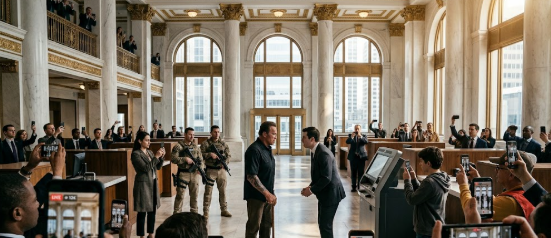
A 65-year-old ex-convict slammed his black card on a luxury bank counter and demanded a balance check… When the bank president finally saw the number on the screen — his hands started shaking.
The marble lobby of Hargrove Private Bank gleamed under crystal chandeliers. Everything here was deliberate — the hushed voices, the gold fixtures, the way tellers smiled without showing their teeth. This was a place where wealth didn’t speak. It whispered.
Until Victor Soren walked in.
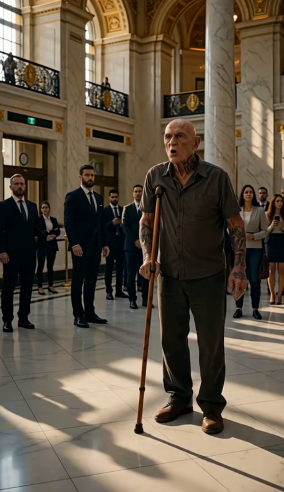
He was sixty-five, though you might have guessed older. Prison had a way of adding years that calendars couldn’t account for. His leather jacket was worn at the elbows, his silver hair cut close to the skull, and a deep scar ran along his left cheekbone — the kind of mark that made people look away quickly in polite company. He walked without rushing, the way men walk when they’ve learned that urgency is a luxury, and patience is survival.
He stopped at the nearest teller window.
“Check my balance,” he said. Not a question.
The young teller, Alina, looked up with her practiced smile. “Of course, sir. Your card?”
Victor placed it on the counter. Didn’t drop it — placed it. Deliberately. A matte black card with no logo, no name. Just a raised serial number and a chip that caught the light wrong, like polished obsidian.
Alina stared at it half a second too long.
From across the lobby, Charles Hayes was already moving — president of Hargrove, third generation, bespoke suit. He had a particular gift: the ability to identify, within moments, who didn’t belong. And the sixty-five-year-old man with the scar and the worn jacket wasn’t even close to belonging.
“Is there a problem here?” Hayes asked, chin slightly raised.
“No problem,” Victor said, not turning. “Just checking my balance.”
Hayes glanced at the card. Something flickered across his face — he buried it quickly, replacing it with a smile like a paper cut.
“Sir, I think you may have walked into the wrong branch. This is a private institution. Perhaps a community bank would be better suited to your—”
“I know exactly where I am,” Victor said.
He finally turned. His eyes were flat and still, like a frozen lake in January. Sixty-five years old, and not one of them wasted on apology.
“You have three seconds to put that card in your terminal,” he said quietly, “before I make a call that ruins the rest of your career.”
The lobby had gone silent. Hayes felt the weight of every eye in the room and made the calculation men like him always make — he picked up the card with theatrical indifference and walked to the main terminal behind the counter.
He inserted the card. Typed the access code. Waited.
The screen loaded.
And Charles Hayes stopped moving.
His fingers hovered over the keyboard. He typed again — slower. A verification prompt appeared. He entered his override credentials with the careful precision of a man who needed to be absolutely sure he wasn’t losing his mind.
The screen refreshed.
His face had turned the color of old wax.
Alina leaned forward without meaning to. “Mr. Hayes?”
He didn’t answer. His eyes moved across the screen in small, rapid jumps — the way eyes move when the brain simply refuses to process what they’re seeing. He typed a third time. A fourth. Each keystroke slower, more desperate than the last.
The room held its breath.
Victor placed one hand flat on the counter. “Well?”
Hayes looked up. For the first time in perhaps twenty years, he had no script. No smile. No polished line ready to go. His voice came out barely above a whisper.
“This account,” he said slowly, “controls our parent holding company.”
A sound moved through the lobby — not words, just air. A stunned, collective exhale.
Victor looked at him for a long moment. Then he lifted the card from the terminal, slid it into his inside jacket pocket, and said:
“I went in at thirty-eight. I came out at fifty-two. I spent the next thirteen years rebuilding everything they said I’d never have again.” He paused. “Today I just wanted to check my balance. That’s all.”
He turned and walked toward the door. Sixty-five years old. Steady. Unhurried. Unbroken.
Nobody stopped him. Nobody spoke. Charles Hayes stood motionless at the terminal, staring at a glowing screen with a number that had rearranged everything he thought he knew about the lobby, the bank, and the quiet scarred man who had just walked out of it.
Leave a Reply