
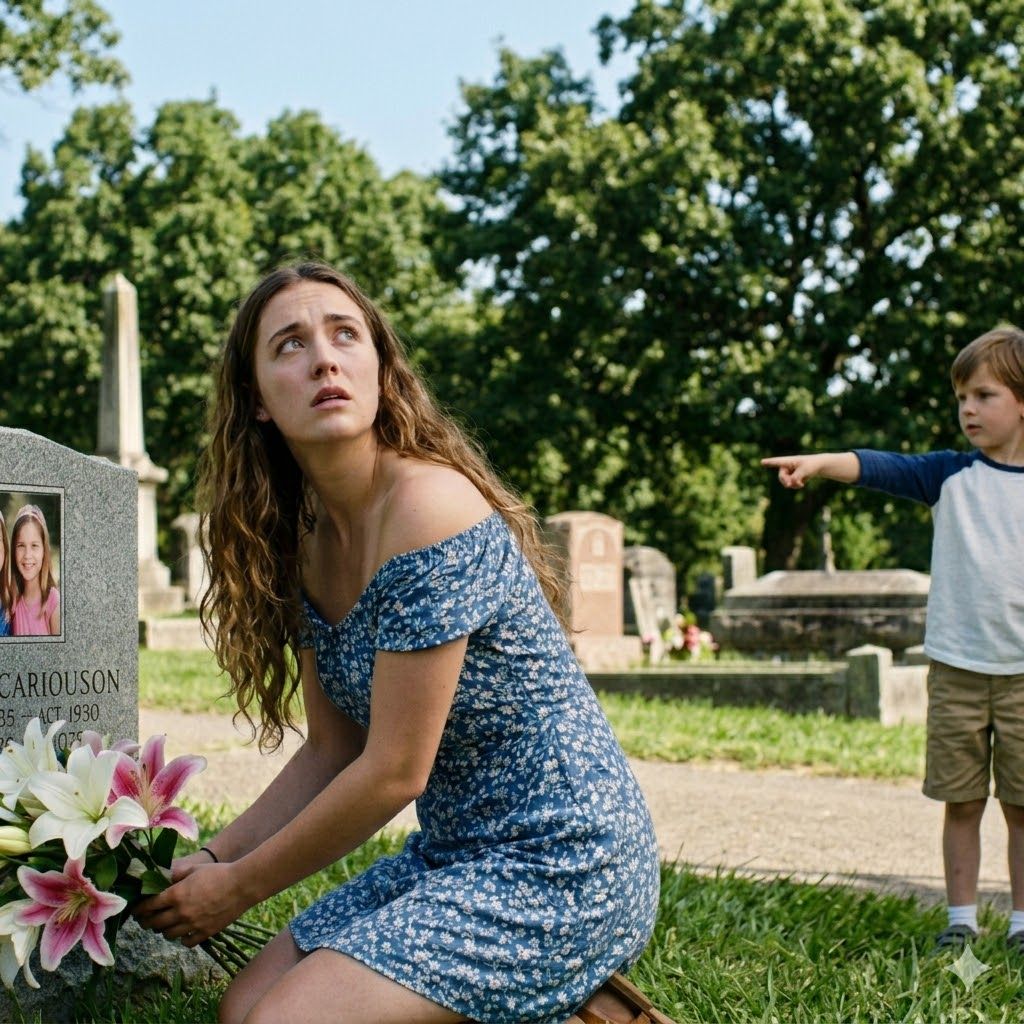
I count my steps to their grave. I always have.
34. 35. 36.
It’s the only ritual left that feels like it belongs to me.
That March morning I was clutching white lilies for Ava and pink ones for Mia, and the wind was doing what March wind always does — cutting through everything, reaching places you’ve long since tried to seal shut. I hadn’t even reached their headstone when I heard it.
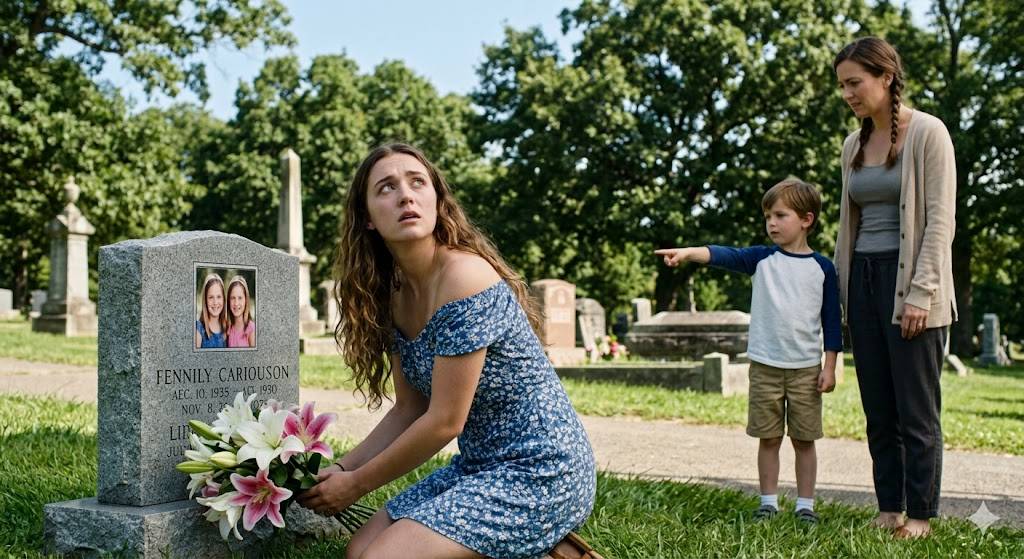
“Mom… those girls are in my class!”
A little boy. Red cheeks. Wide eyes. Arm extended, finger aimed directly at the stone where my daughters’ faces are etched in granite forever.
I turned so slowly I thought the world had stopped.
Ava and Mia died when they were five. They died on a night that should have been ordinary — a gala, a babysitter, an hour of giggles while they dared each other to balance on couch cushions. “Careful,” I had told them from the doorway, barely holding back my smile. “Your father will blame me if someone falls.” Ava had grinned. Mia stuck out her tongue.
That was the last easy moment I had.
The rest comes back to me only in pieces. A ringing phone. Sirens too far away to be real. Stuart saying my name, my name, my name, until the word stopped sounding like me.
I bit my tongue so hard I tasted blood.
I barely remember the funeral. What I remember is the sound of Stuart leaving our bedroom that night — the soft click of the door, small and final as a period at the end of everything.
For two years I carried the belief that I had caused it somehow. That I had said the wrong thing, left at the wrong moment, trusted the wrong person.
I was right about one part.
“He must be mistaken,” the boy’s mother said, pulling his arm down gently. But I asked her to let him speak. And the boy — Eli, she called him — looked at me with the calm certainty only children manage and said: “Demi brought them. They’re on our wall at school. She said they’re her sisters and they live in the clouds now.”
Demi.
The name landed like a stone dropped from a great height.
Macy’s daughter.
Macy had been the babysitter that night.
I drove home and paced my kitchen until the counter felt like a railing on a ship I couldn’t get off. Then I called the school. Then I went in. And there, pinned to a memory board between a photo of someone’s golden retriever and a grandmother’s birthday portrait, were my daughters.
Pajamas. Ice cream on their faces. Grinning.
And Demi between them, holding Mia’s wrist like she owned her.
The teacher told me Macy had brought the photo. Said the loss had been hard on Demi too.
That evening I went to Macy’s house.
She opened the door already shaking.
“I kept meaning to call,” she started. I didn’t let her finish.
“Why do you have a photo from that night?”
She told me everything then, in pieces, the way truth always comes when it’s been held too long. She hadn’t been called away to an emergency with Demi. That was a lie she told the police. What had actually happened: she’d picked up the twins first, decided to stop for ice cream, told herself it would only take ten minutes. Demi was in the front seat. The twins were in the back.
The accident happened on the way home.
Demi and Macy walked away with scratches.
Ava and Mia did not walk away at all.
“Stuart knew,” I said. It wasn’t a question by then.
She nodded. He’d found out after the funeral. He’d been furious — but he’d told her to stay quiet. Told her the truth would break me. That it wouldn’t change anything.
What it changed was this: for two years I had grieved as though I were somehow responsible. As though my ordinary evening out had been a crime. And while I carried that weight, the two people who actually knew the truth had decided, together, that I didn’t deserve to know it.
I confronted Stuart at his mother’s charity gala. I know how that sounds. But I had spent two years learning that quiet rooms and closed doors were how things stayed buried, and I was done with burial.
I said it clearly, in front of people who had watched me grieve, who had shaken my hand at the funeral and said they were sorry for my loss while my husband stood behind me holding a secret that was never his to keep.
Stuart went pale. His mother stared at him the way only mothers can — like she was seeing him for the first time and wishing she wasn’t.
“It was still an accident,” he said.
“It was,” I agreed. “But what came after wasn’t.”
I didn’t wait for his answer. I turned and walked out through the crowd, and no one stopped me, and the night air hit me like the first breath after surfacing from deep water.
A week later I went back to the grave.
I brought tulips this time.
“I’m still here, babies,” I said, pressing my fingers to the cold stone. “I know the truth now. And none of it was mine to carry.”
I stood up straight.
And I walked away — for the first time in two years — without looking back.
Leave a Reply