
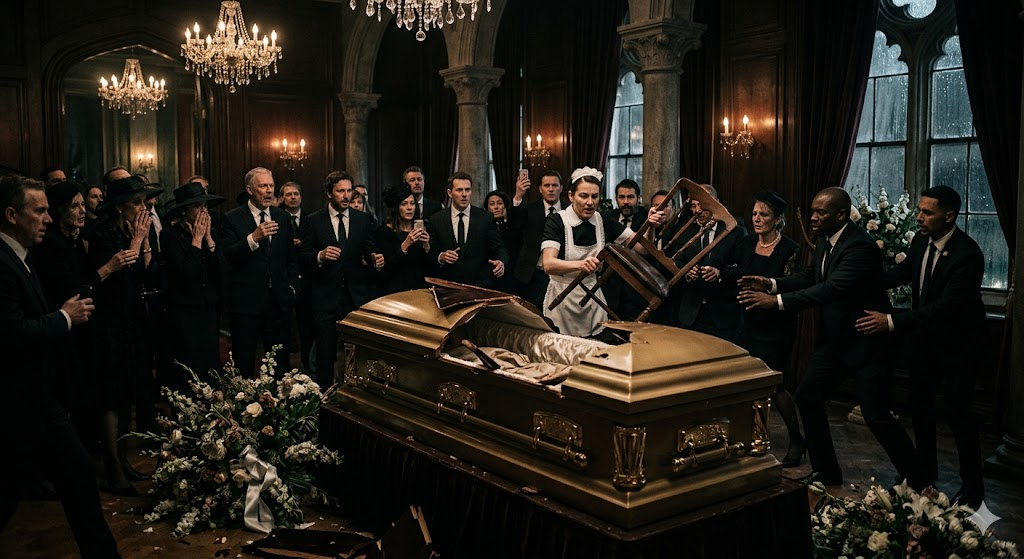
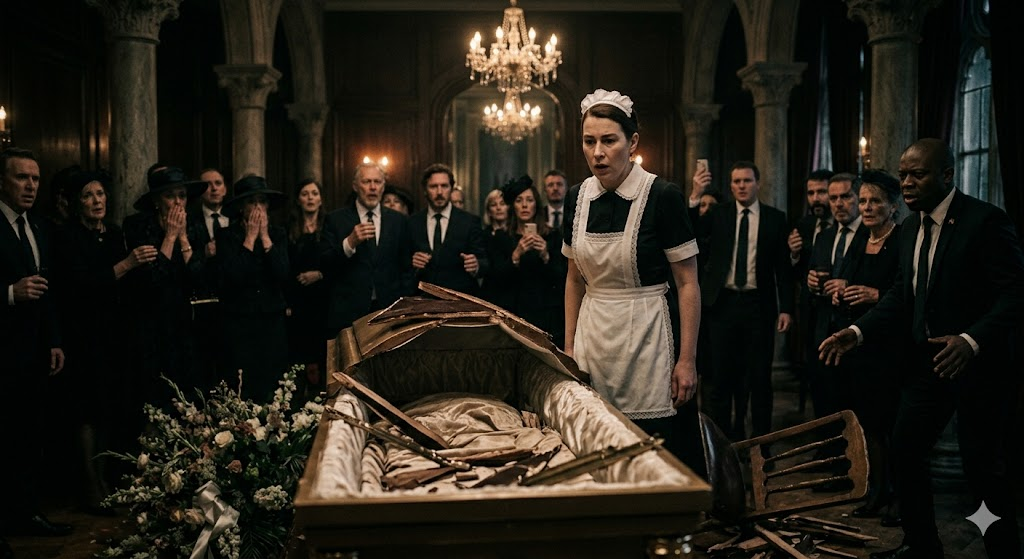
A maid crashed a billionaire’s funeral and smashed open the coffin. There was no body inside.
She had been invisible for six years.
That is the thing about maids. They learn the rhythm of a house the way a doctor learns a heartbeat—every skip, every pause, every change that shouldn’t be there. Elena had cleaned rooms most of the family didn’t know existed. She had carried trays to hallways with no windows and mopped floors no guest had ever stepped on. She had, over time, become furniture.
The billionaire’s wife, Mara, had chosen her for exactly that reason.
“You don’t look,” Mara had told her once, standing at the tall library window, the grounds stretching gold and green below. It was meant as a compliment.
Elena had learned not to answer those.
She just worked. She arrived early and left late. She replaced the flowers on the east corridor every Tuesday. She learned which rooms to skip when the patriarch was home, which staircases to avoid when the sons were in from the city. She kept her eyes on the floor and her ears open, because quiet people hear everything.
She heard the fights that were never public. She heard the names of lawyers called at midnight. She heard the word “transfer” used in ways that had nothing to do with banks, and she heard the silence that followed when Mara stopped speaking at dinner altogether.
She noticed when Mara began losing weight.
Not the graceful kind. The frightened kind.
Three weeks before the funeral, Mara had called her into the small sitting room off the garden—the one with pale curtains and no security camera. Elena had stood at the door, uncertain. Mara was already sitting, still dressed from dinner, the pearls still at her throat.
“Sit,” Mara said.
Elena sat.
Mara didn’t speak for a long time. She looked at her hands. Then she said, very carefully, as if rehearsing something: “They will say I collapsed.”
Elena waited.
“Then they’ll say I died peacefully.” Mara’s eyes flicked to the door and back. “If that happens—do not believe them.”
“Ma’am—”
“Don’t.” Mara gripped her wrist. Her grip was stronger than it should have been for someone that pale. “I need one person in this house to not believe them. Just one. Can you do that?”
Elena had nodded. She had not known what else to do.
That night she found the message. She almost missed it—a seam in the pale curtain, slightly thicker than it should have been, a neat row of stitches in ivory thread on ivory fabric. She had only noticed because she was the one who cleaned those curtains and she knew every inch of them.
She used her nail to open the seam.
Inside: a folded slip of paper.
If I disappear, look where grief is performed.
By morning, Mara was hospitalized.
By evening, the family released a statement: she was unconscious, resting, being cared for. By the second night, the story had shifted—complications, they said. By the third day, she was dead.
It happened so fast that Elena stood in the kitchen holding a tray of untouched food and couldn’t understand how a woman who had gripped her wrist hard enough to leave a mark could now be gone.
She noticed things in the days after.
The ring Mara always wore—the thin gold one, not the diamonds—was missing from the description of personal effects returned to the family. The basement room that had been locked for years was suddenly unlocked, then repainted within forty-eight hours, the smell of fresh paint sharp and strange. A black suitcase was removed from the east wing before dawn on the second day by two men she did not recognize. And the hospital report, when she heard the family discussing it, had arrived unsigned.
There was no autopsy.
The patriarch had refused it. Respect, he said. She wouldn’t have wanted that.
Elena had cleaned enough of this house to know that respect was not something they spent on each other freely.
She went to the funeral because she had nowhere else to go with what she knew. She wore her black work uniform, clean and pressed. She was not supposed to be there—staff had not been invited—but the cemetery was large and the morning was grey and no one stopped a woman in black from standing at the edge of a crowd of black coats.
The coffin was magnificent. Polished mahogany, gold handles, the quiet extravagance of real money. It came on a trolley guided by white-gloved men, and the family arranged themselves around it with the precision of people who had rehearsed.
Elena watched the patriarch. She watched his hands. She watched him not look at the coffin once.
Look where grief is performed.
When they began to lower it, she moved.
She didn’t plan it exactly. She had spent three days turning it over and rearranging it and telling herself she was wrong, she had misunderstood, grief made people paranoid. But then the coffin began to descend into the earth—sealed, permanent, final—and something in her simply would not allow it.
She stepped forward.
“She isn’t dead.”
Heads turned. Security stiffened. The family froze in that particular way of people who are not used to being interrupted.
The billionaire’s eldest son stepped toward her. “Remove her.”
She didn’t wait. She grabbed the metal lowering bar from a stunned attendant and brought it down on the coffin lid.
The sound was wrong.
She knew it immediately. She had cleaned this house for six years. She knew the difference between full and hollow, between weight and its absence.
She hit it again.
The lid cracked.
The family was shouting now, all the curated grief shattered into something raw and real and panicked. Security was moving. Someone grabbed her arm.
But the lid had broken open.
And there was nothing inside.
No body.
No lining disturbed by a shape.
No presence of any kind.
Just wood and velvet and air.
The cemetery went silent in that particular way that only happens when something has occurred that no amount of money or management can immediately contain. Rain fell. People looked at the patriarch. He was looking at the ground.
His son grabbed his arm. “Father. Where is she?”
The old man said nothing.
The police came. Questions were asked in the careful, soft way that people ask questions of the very wealthy. The family was escorted to cars. Elena was taken to a different car, questioned for two hours, doubted extensively, asked if she was mentally well, asked if she had been drinking, asked if she had a grudge.
She answered: she had a note stitched into a curtain and six years of watching a woman disappear in plain sight.
Doubt, she told them, doesn’t empty a coffin.
She didn’t know exactly where Mara was. She knew only what Mara had said, in that small room with the pale curtains: sometimes the safest place to survive is inside a lie big enough that no one dares question it.
Somewhere behind locked doors and erased records, under a name that no longer existed in any system the family could reach, a woman who had been declared dead was still alive.
Not hiding.
Waiting.
Because she had always known the one thing her family underestimated: that a woman who has been invisible for long enough learns, eventually, how to vanish on her own terms.
Leave a Reply