
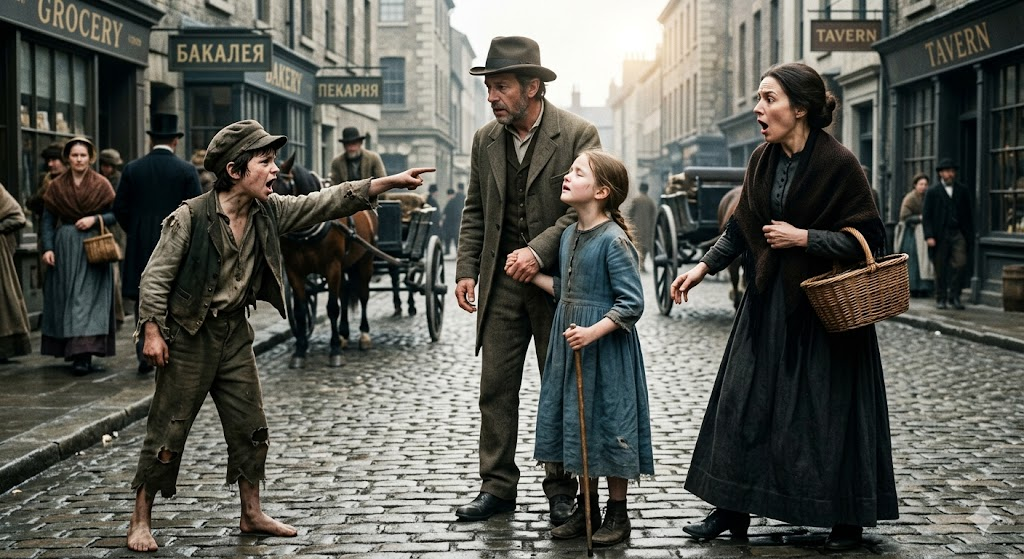
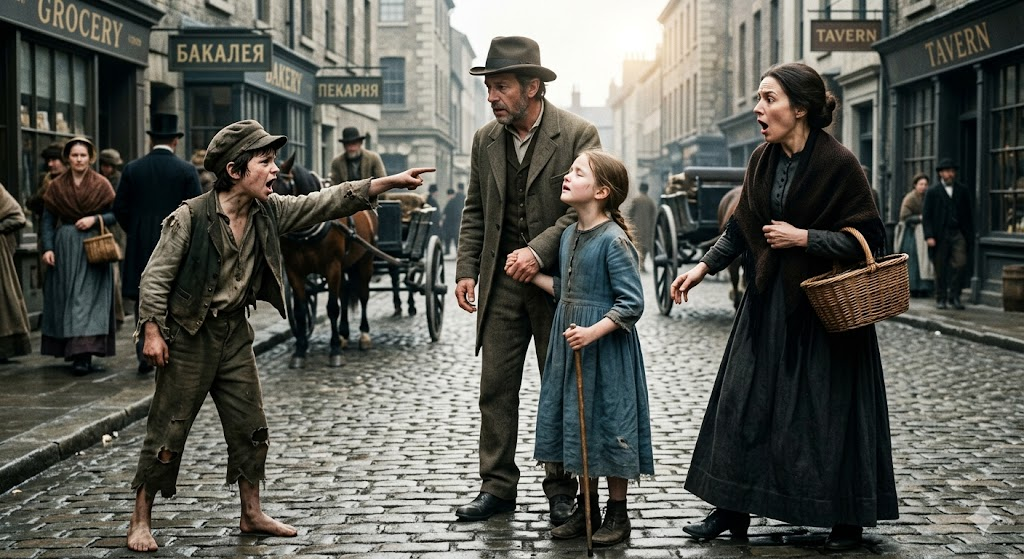
A ragged street boy pointed his finger at a blind girl’s father and said she could see… Then the girl whispered “I see light” — and her mother stopped dead in her tracks.
The afternoon sun hung low over Riverside Park, painting the benches gold. Daniel sat with his daughter Lily, the way he did every Saturday. The ritual felt sacred — her small hand in his, her white cane leaning against the bench, her oversized sunglasses shielding the eyes he hadn’t seen clearly in three years.
He loved her. He would have burned the world for her.
He was watching pigeons scatter across the path when the boy appeared.
He couldn’t have been older than ten. Dirty sneakers. A torn jacket two sizes too big. Dark eyes that didn’t blink the way a child’s should — too still, too focused, like something ancient lived behind them.
The boy stood maybe six feet away and pointed.
Not at Daniel.
At him. Directly. Deliberately.
“Your daughter is not blind.”
The words hit harder than a scream.
Daniel blinked. The park noise didn’t stop — joggers passed, a dog barked somewhere — but it all felt muted, like his ears had filled with water.
“What did you just say to me?” His voice came out slower than he intended. Confusion had a weight to it.
The boy didn’t flinch. Didn’t look away. He stepped one foot closer, that finger still raised.
“She’s not sick.” A pause. Quieter this time, almost a breath. “Someone is doing this to her.”
Daniel’s grip tightened on the bench slats. The wood bit into his palm and he was grateful for the pain because it was real, and what this boy was saying was not real, could not be real.
“Kid, I don’t know who you are or who sent you, but—”
“Marcus!”
The voice came from behind him. His wife’s voice. Claire.
He turned.
She was running across the park lawn, the way you run when something has gone terribly wrong — not jogging, not hurrying, but sprinting, her face twisted into something that looked like panic. Real panic. The kind that can’t be rehearsed.
Daniel turned back to the boy.
The boy had not moved. He had not watched Claire arrive. He was still watching Daniel, with those ancient, unblinking eyes.
“Marcus, don’t listen to him!” Claire called out, getting closer. Too fast. Too desperate.
Something curled in Daniel’s stomach. A cold, formless thing.
He thought: why is she running like that?
He thought: how does she know what he said?
He thought: she was fifty yards away.
He didn’t finish the thought. Because beside him, something moved.
Small. Unexpected.
Lily turned her head.
Not toward her mother’s voice — every blind child turns toward a voice they recognize. Lily had always done that. It was one of the things Daniel had memorized, one of the little maps he’d drawn of her world.
She turned toward the boy.
Slowly. Precisely.
Like someone following a light they can almost see.
Daniel’s breath stopped.
Her lips parted. Her chin dropped slightly. And in a voice he had not heard from her in three years — uncertain, trembling, like someone surfacing from deep water — she said:
“…Daddy…”
He couldn’t speak.
“…I see light…”
The world folded.
He heard Claire stop running. Not slow down — stop. The sound of her footsteps simply ended. And in the silence that followed, Daniel heard his own heartbeat for the first time in years.
He turned toward his wife.
She stood ten feet away. Her expression had changed. The panic was still there, but beneath it, exposed now like bone beneath torn skin, was something else.
Guilt.
The specific, nauseating guilt of someone who has been caught.
“Claire.” His voice didn’t sound like his own. “What is she taking?”
Silence.
“What are you giving her?”
Claire shook her head, and the movement was too small, too controlled, the way people move when they’re deciding how much of the truth to offer.
“Marcus, he’s a child, he doesn’t know what he’s—”
“She just said she sees light.” The words came out flat. Each one a separate stone. “She hasn’t said anything like that in three years. Not since the diagnosis.” He paused. “The diagnosis you pushed for. The specialist you found. The prescription you manage.”
The pigeons scattered again. The dog barked. Life kept moving around them, indifferent.
Lily was still facing the boy. Her head tilted slightly, the way she used to tilt it toward windows before all of this started.
Daniel stood.
He looked at his wife — this woman he had trusted completely, this woman he had held while he wept about his daughter’s future, this woman who had chosen the doctors and driven to every appointment and managed every medication with such careful, loving precision.
He looked at the boy.
The boy, who was already stepping back. One step. Then another.
His expression hadn’t changed. No triumph. No satisfaction. Just that same ancient steadiness, as if he had done the thing he came to do and the rest was no longer his to carry.
Daniel opened his mouth.
And the boy whispered:
“…you’re too late.”
Then he turned and walked away through the pigeons and the gold light and the Saturday noise, and he did not look back.
Daniel stood between his daughter and his wife.
Lily’s hand reached up slowly and found the edge of her sunglasses.
And for the first time in three years, she pulled them off.
Her eyes — blinking, adjusting, overwhelmed — turned toward the light.
Toward the sun.
Toward her father’s face.
And Daniel understood that whatever came next — whatever truths had to be excavated, whatever world had to be dismantled and rebuilt — it would begin here.
In a park.
On a Saturday.
Because a dirty boy in a torn jacket had pointed at a man who should have looked closer, and told him the one thing no one else had dared to say.
Leave a Reply